
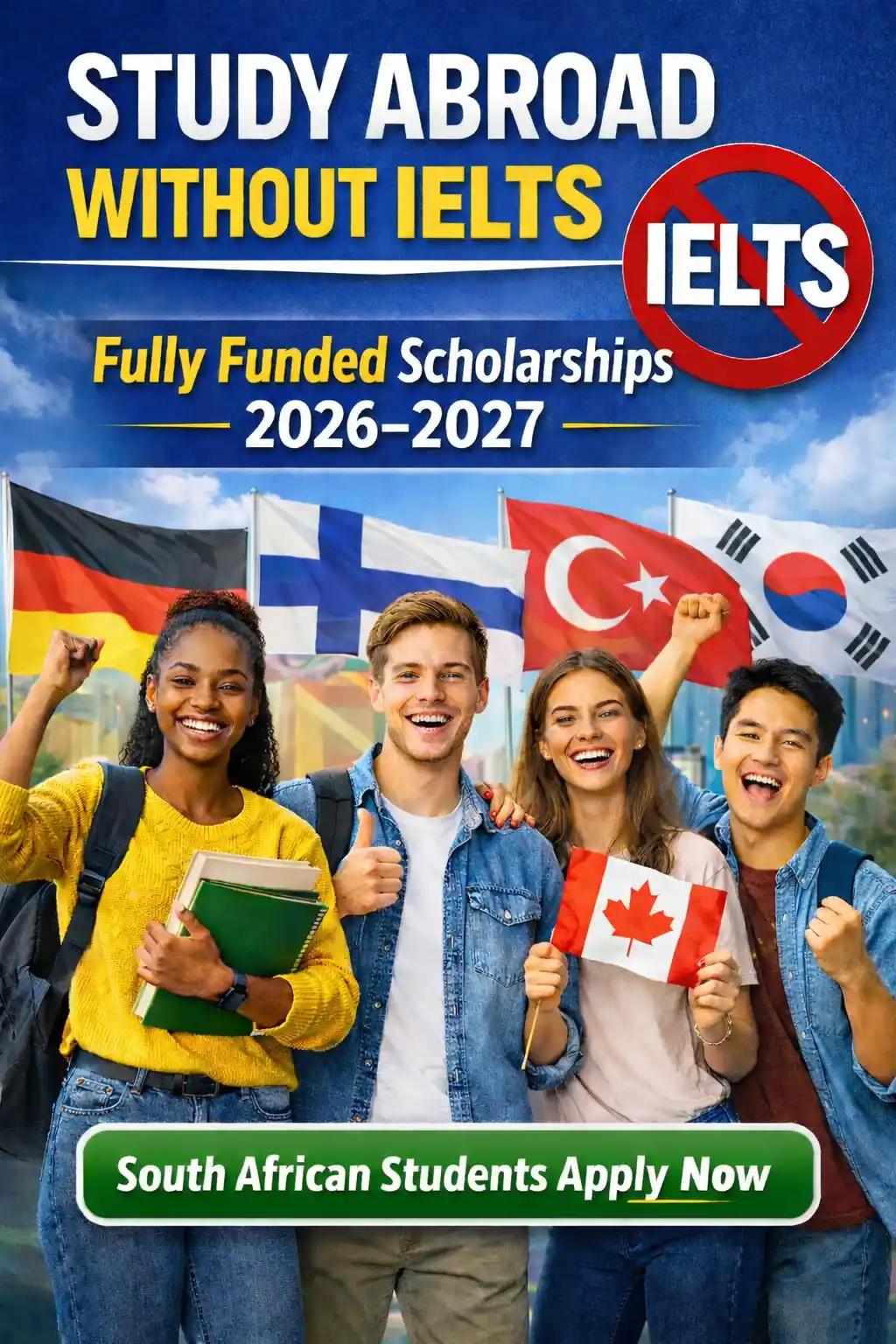
Fully Funded Scholarships Without IELTS for South African Students 2026–2027I. Apply for fully funded scholarships here. If you are a South African student dreaming of studying abroad without sitting the IELTS exam, 2026 and 2027 bring some of the most exciting fully funded scholarship opportunities you will ever find. These programs offer complete study visa sponsorship, covering everything from tuition to airfare, making the dream of international education genuinely accessible. Many of these scholarships also open a clear immigration pathway for graduates who wish to build long-term careers and residency in their host country. Whether you are applying for undergraduate, postgraduate, or doctoral study, these opportunities are designed for motivated South African students ready to take the next step.
| Field | Details |
| Scholarship Name | Multiple Fully Funded Scholarships Without IELTS (2026–2027) |
| Host Country | Germany, China, Turkey, Hungary, Czech Republic, Russia, Japan, and others |
| Eligible Nationalities | South African Citizens and Permanent Residents |
| Study Level | Undergraduate, Master’s, PhD, and Postdoctoral |
| Scholarship Type | Fully Funded (Government and University-Sponsored) |
| Funding Coverage | Tuition, accommodation, stipend, airfare, health insurance |
| Application Deadline | Varies by program |
| Official Website Link | See Section 13 for official links per country |
Complete Financial Benefits and Cost Breakdown
One of the most important reasons South African students pursue these scholarships is the complete elimination of financial stress during their studies abroad. Unlike taking an education loan alternative or relying on financial aid for international students that comes with repayment obligations, these scholarships cover your costs in full. The student finance options packaged into these awards are genuinely comprehensive, and understanding exactly what is included helps you plan your move with confidence. Here is a full breakdown of what most of these fully funded programs offer.
| Benefit | Amount or Details |
| Full Tuition Fee Waiver | 100% covered by sponsoring government or university |
| Monthly Living Stipend | Approx. USD 300–900 depending on host country |
| University Accommodation | On-campus dormitory or equivalent housing provided |
| Annual Return Airfare | One or two return tickets per year included |
| Health and Medical Insurance | Comprehensive plan provided for duration of study |
| Research or Book Allowance | USD 100–300 per semester for academic materials |
| Visa Fee Reimbursement | Available in selected programs (e.g., DAAD, CSC) |
| Family Allowance | Offered in some PhD and postdoctoral programs |
Students who do not secure full funding should know that international student loans, education financing from banks such as ABSA Education Loans or Standard Bank, and partial scholarship combinations can be combined to cover any remaining costs. Many South African banks offer education financing for study abroad with competitive interest rates, and it is worth comparing these options with the help of a financial advisor before you commit to a specific funding strategy.
Why You Need an Immigration Consultant or Education Advisor
Navigating the international scholarship and visa application process without professional guidance is one of the most common reasons South African students face rejection or unnecessary delays. A qualified immigration consultant brings deep expertise in documentation requirements, embassy procedures, and country-specific rules that can be genuinely difficult to understand without experience. Immigration lawyers can also assist with visa rejection appeals, document verification, and planning your long-term PR pathway, which is especially valuable if your goal extends beyond just completing a degree.
Many students hire student visa consultants specifically to avoid the small but critical mistakes — wrong form versions, missing attestations, or incorrect financial proof formatting — that instantly invalidate an application. An international student recruitment agency can go even further, helping you shortlist universities that match your profile, submit a strong application, and file your visa documents with precision, significantly increasing your chances of success from the very first attempt.
Available Study Programs for International Students
The range of programs available to South African students under these no-IELTS scholarship schemes is remarkably broad, covering everything from technology and medicine to law and the creative arts. Whether you are a science student or a social science enthusiast, there is almost certainly a program and a host country that aligns with your ambitions. These programs are offered at top universities with strong global rankings and outstanding career placement records. Below are ten of the most popular study fields, along with their job market potential.
Computer Science and Artificial Intelligence
Computer science and AI remain the most in-demand fields globally, with average starting salaries for software engineers ranging from USD 60,000 to USD 110,000 per year in countries like Germany, Canada, and Australia. South African students with strong maths and coding backgrounds are especially competitive for these scholarships. The AI sector is growing at over 35% annually, making this one of the most future-proof career choices available.
Medicine and Healthcare
Medical degrees funded by government scholarships — particularly through programs in China, Russia, and Hungary — are highly sought after by South African applicants. Doctors trained internationally typically earn between USD 80,000 and USD 200,000 per year depending on specialisation and country. The global shortage of healthcare professionals also makes it easier for internationally trained doctors to secure work permits after study.
Business Administration and MBA
An internationally accredited MBA from a top European or Asian university can transform a South African graduate’s career trajectory, opening doors to management roles that pay between USD 70,000 and USD 150,000 annually. Many business programs are taught entirely in English and do not require IELTS if applicants can demonstrate English proficiency through prior education. Business graduates are also highly eligible for skilled worker visas in most destination countries.
Civil and Mechanical Engineering
Engineering is one of the most globally transferable qualifications, and South African engineers trained abroad often command salaries of USD 55,000 to USD 120,000 depending on specialisation. Germany’s DAAD scholarship, in particular, has a strong track record of funding engineering students from Africa. Infrastructure development worldwide means that civil and mechanical engineers face strong and consistent demand in virtually every market.
Law and International Relations
Studying law or international relations abroad equips South African graduates with a globally recognised legal framework, useful for careers in diplomacy, international trade, or human rights. Average salaries for international lawyers range from USD 70,000 to USD 180,000 per year in Western markets. Many law graduates also benefit from immigration pathways that prioritise highly skilled professionals.
Environmental Science and Sustainability
Climate change and sustainability are among the fastest-growing focus areas in government funding, making environmental science one of the most strategically wise choices for scholarship applicants in 2026. Careers in renewable energy, environmental consulting, and policy pay between USD 50,000 and USD 90,000 in most developed economies. South Africa’s own environmental challenges make returning graduates particularly valuable to local government and NGO sectors.
Data Science and Analytics
Data science roles are among the highest-paying entry-level positions in the technology sector, with salaries starting around USD 65,000 and climbing past USD 130,000 for experienced professionals. Universities in Germany, Finland, and South Korea offer strong data science programs accessible to South African students without IELTS. As companies worldwide compete for data talent, this degree virtually guarantees strong employment prospects.
Education and Teaching
Education degrees from internationally recognised institutions carry strong weight for South Africans seeking to work in schools or universities abroad. Teaching roles in Germany, Japan, and South Korea pay between USD 35,000 and USD 65,000 annually and often come with excellent social benefits. Several funded teaching scholarships specifically target candidates from African nations.
Architecture and Urban Planning
Architecture and urban planning graduates from top international universities are highly sought after in countries experiencing rapid infrastructure development. Salaries range from USD 50,000 to USD 100,000 and are often higher in the Gulf states and East Asian markets. Many architecture scholarships also include studio fees and project materials as part of their funding package.
Economics and Finance
An economics or finance degree from a globally ranked institution is one of the strongest tickets to high-paying roles in banking, investment management, and economic policy. Entry-level economists and finance analysts in Europe and North America typically earn USD 55,000 to USD 100,000. South African students with strong quantitative skills are particularly competitive applicants for these programs.
Top Universities in South Africa’s Destination Countries for International Students
Choosing the right university is just as important as winning the scholarship itself, because the prestige and accreditation of your degree will directly affect your employment and immigration prospects after graduation. University admission consultants can help you identify which programs align with your academic record and career goals, and can significantly improve the quality of your application documents. Below are some of the most respected universities in top destination countries that accept South African students through no-IELTS scholarship schemes.
Technische Universität München (TUM) — Germany
Located in Munich and consistently ranked among Europe’s top five engineering universities, TUM offers a wide range of English-taught postgraduate programs. Its acceptance rate for international students is around 20–30%, and annual tuition fees for non-EU students are relatively low at approximately EUR 3,000–5,000 per year. Several DAAD-funded scholarships make TUM accessible at zero cost for eligible applicants.
Peking University — China
Peking University is China’s most prestigious institution and actively recruits African students through the Chinese Government Scholarship (CSC). International students have an acceptance rate of around 25–35%, and the CSC scholarship covers all tuition, accommodation, and living costs. English-medium programs are available and no IELTS is required when your previous education was in English.
Istanbul University — Turkey
Istanbul University participates in the Türkiye Burslari (Turkish Government Scholarship), which is one of the most generous no-IELTS scholarship schemes for South African students. Acceptance rates for scholarship applicants run around 10–15% due to high competition, but strong academic records significantly improve your chances. Tuition, accommodation, health insurance, and a monthly stipend are all fully covered.
Budapest University of Technology and Economics — Hungary
Hungary’s Stipendium Hungaricum scholarship has become one of the most popular fully funded opportunities for South African students, and this university is among its top partner institutions. Tuition fees for self-funded international students range from EUR 4,000 to EUR 8,000 per year, all of which is waived under the scholarship. English-language programs are offered across engineering, IT, and business disciplines.
University of Tokyo — Japan
The University of Tokyo is Asia’s top-ranked university and receives funding from Japan’s MEXT government scholarship for international students. Acceptance rates are competitive at around 20–25%, and the MEXT scholarship covers all academic and living expenses. While some programs are in Japanese, an increasing number of postgraduate programs are fully English-taught.
Lomonosov Moscow State University — Russia
Russia’s most famous university offers fully funded Russian Government Scholarships to South African students across medicine, engineering, and sciences. Annual tuition for self-funded students ranges from USD 3,000 to USD 8,000, but scholarship holders pay nothing. English-medium programs are available, and IELTS is not required for non-Russian-language programs.
Masaryk University — Czech Republic
Masaryk University in Brno is one of Central Europe’s most student-friendly institutions and actively recruits international students from Africa. Tuition fees range from EUR 2,000 to EUR 6,000 per year for English programs, with several full scholarship pathways available through both the Czech government and the university itself. The acceptance rate for international applicants is around 30–40%.
How to Choose the Right Education Consultant for South Africa
With so many agencies advertising overseas education services, choosing the right education consultant is one of the most critical decisions you will make as a South African student planning to study abroad. Fake or unregistered consultants are unfortunately common and have caused thousands of students to receive visa rejections, lose application fees, and miss scholarship deadlines due to incorrect advice.
You should always verify that the consultant or agency you are working with is a licensed education agency recognised by both the host country’s immigration authority and reputable professional bodies. Registered immigration consultants and certified visa consultants will always be transparent about their fees, have documented success rates, and will not make guarantees that sound too good to be true. Taking the time to verify credentials before paying any fees can save you months of wasted effort and significant financial loss.
RCIC or Equivalent Certification
For consultants helping with Canadian applications, look for Regulated Canadian Immigration Consultants (RCIC) certification. For other countries, check that your consultant is registered with the relevant national immigration authority. Working with a certified professional dramatically reduces the risk of procedural errors.
Transparent Fee Structure
A trustworthy education consultant will give you a written breakdown of all fees before you sign anything. Be wary of anyone who asks for large upfront payments without a service agreement. Legitimate consultants charge fair, market-rate fees and never demand payments through informal channels.
Success Rate History
Ask your consultant directly how many South African students they have successfully placed in the past two years. A reputable agency will have verifiable testimonials, documented case studies, and a clear track record of visa approvals and scholarship wins.
Post-Visa Support
The best education consultants do not disappear after your visa is approved. Look for agencies that offer pre-departure briefings, airport pickup coordination, and student accommodation advice to help you settle smoothly in your new country.
Embassy Network
Consultants with established relationships with embassies, university admission offices, and immigration departments can often expedite processes and provide timely updates on changing requirements. This network is especially valuable when you face unexpected complications in your application.
Student Visa Requirements for Destination Countries
Understanding the visa requirements for your target country well in advance is essential, and many South African students choose to work with student visa consultants specifically to avoid the errors that lead to rejection. Visa requirements vary significantly between countries, and missing even one document can delay your entire application by months. The table below provides a general overview of what most destination countries require from South African scholarship applicants.
| Requirement | Details |
| Visa Type and Name | Student Visa / Study Permit (varies by country) |
| Proof of University Admission | Conditional or unconditional offer letter from an accredited institution |
| Proof of Financial Funds | Bank statements or scholarship award letter confirming full funding |
| Valid Passport Validity | At least 6 months beyond the intended study period |
| Medical Examination Certificate | From a government-approved medical practitioner |
| Language Proficiency Test Score | IELTS waived for many no-IELTS programs; MOI letter accepted instead |
| Biometric Enrollment | Required by most countries at designated visa centres |
| Visa Application Fee | USD 50–350 depending on destination country |
| Average Processing Time | 4–12 weeks from submission |
| Health Insurance Requirement | Mandatory in most countries; some provide it through the scholarship |
International student health insurance is a non-negotiable visa requirement in most destination countries, and South African students should compare student insurance plans carefully before their visa appointment. Some scholarships include this coverage automatically, but in cases where it is not included, you will need to purchase a plan from a recognised insurer before submitting your visa application.
International Student Health Insurance Guide
Health insurance for international students is not just a recommended precaution — it is a mandatory visa requirement in Germany, China, Hungary, Turkey, and most other popular destinations for South African scholarship holders. Without valid health coverage, your visa application will be rejected outright, regardless of how strong the rest of your documentation is. Most scholarship programs include comprehensive university health plans as part of the award, but students on partial funding or self-funded exchanges must arrange private student insurance independently.
When comparing plans, check for coverage of dental treatment, mental health support, emergency medical evacuation, and prescription drugs, since these are the areas where gaps most commonly cause problems for students abroad. Prices for adequate international student health coverage typically range from USD 40 to USD 120 per month, and comparison platforms allow you to find the best health coverage for students abroad that satisfies your destination country’s medical insurance requirement for a study visa. Affordable insurance for international students exists — you simply need to shop carefully and start the process early.
Step-by-Step Scholarship and Study Visa Application Process
The scholarship and visa application process for South African students involves multiple stages that each require careful preparation and attention to detail. Getting the sequence right is crucial, because submitting a visa application before your scholarship is confirmed, or an application before your documents are complete, leads to rejection and wasted fees. Below is a clear, step-by-step guide to help you navigate the entire process from research to arrival.
Step 1: Research and Shortlist Scholarships
Begin at least 12 months before your intended start date by identifying all scholarships that are open to South African students and that do not require IELTS. Use official government scholarship portals, university websites, and reputable scholarship databases to build your shortlist. Note each program’s funding coverage, deadline, and eligibility criteria so you can prioritise the most suitable opportunities.
Step 2: Check Eligibility Criteria Carefully
Each scholarship has specific requirements around nationality, age, academic results, field of study, and sometimes employment history. Read every eligibility condition thoroughly before investing time in an application, as applying to a scholarship you do not qualify for wastes your time and can occasionally affect your record with that institution. If you are unsure about a specific requirement, contact the scholarship office directly or speak to an education consultant for clarification.
Step 3: Prepare All Required Documents
Document preparation is one of the most time-consuming parts of the process and should begin months in advance. You will typically need certified copies of academic transcripts, degree certificates, your passport, a personal statement, letters of recommendation, and a CV. Some countries require document attestation from the Department of International Relations and Cooperation (DIRCO) in South Africa, so factor in extra time for this.
Step 4: Give IELTS or Required Language Test
Even for no-IELTS scholarships, you may need to demonstrate English proficiency through a Medium of Instruction (MOI) letter from your previous institution, or through an interview. If the scholarship requires a language test other than IELTS — such as the Goethe-Zertifikat for Germany or a Chinese language test — start preparation at least six months in advance. Taking language preparation seriously can make the difference between an offer and a rejection.
Step 5: Submit Scholarship Application Online
Most scholarship applications are submitted through official online portals, and late or incomplete submissions are typically rejected automatically. Double-check every field before submitting and keep copies of all uploaded documents. Set a calendar reminder for one week before the deadline so you have time to address any last-minute issues.
Step 6: Receive Conditional or Unconditional Offer Letter
Once your application is reviewed, the university or scholarship body will issue either a conditional offer (dependent on final results or additional documents) or an unconditional offer confirming your place. This letter is a critical document for your visa application, so store it securely in both digital and physical formats. If you receive a conditional offer, fulfil the conditions as quickly as possible to secure your place.
Step 7: Apply for Student Visa with Full Documents
With your scholarship confirmation and university offer letter in hand, you can proceed to apply for your student visa through the relevant embassy or visa application centre. This is the stage where working with an immigration consultant is most valuable, as they can review your entire document package before submission and ensure everything meets the embassy’s current requirements. Errors at this stage are the leading cause of visa rejection for South African students.
Step 8: Book and Attend Visa Interview at Embassy
Some countries, including the United States and certain European nations, require an in-person interview at the embassy as part of the visa process. Book your appointment as early as possible since wait times at the South African embassies can extend several weeks. Dress professionally, bring all original and certified copies of your documents, and answer interview questions honestly and confidently.
Step 9: Receive Visa and Arrange Accommodation
Once your visa is approved, begin arranging your student accommodation immediately if it is not already provided by the scholarship. Many students use relocation services for students to help them find furnished rooms near their university, handle lease agreements, and understand local housing laws. Most universities have international student offices that can connect you with trusted housing partners, student dormitories, and off-campus housing options.
Step 10: Arrive and Complete University Enrollment
On arrival, you will need to complete your university enrollment in person, register with local immigration authorities (required in countries like Germany and China), and activate your health insurance. Attend your university’s international student orientation programme, which will help you navigate the campus, connect with student services, and understand your academic obligations. Starting strong in the first semester sets the tone for your entire international education experience.
Required Documents Checklist
Preparing your documents correctly and in the right order is one of the most critical factors in a successful scholarship and visa application. Education consultants regularly help South African students with document attestation, certified translations, and DIRCO verification, which can be confusing and time-consuming without professional guidance. Use the table below as your comprehensive reference throughout the application process.
| Document | Required or Optional | Important Notes |
| Valid Passport | Required | Must be valid for at least 6 months beyond study end date |
| Academic Transcripts | Required | Certified copies from each institution attended |
| Degree Certificates | Required | Attested by DIRCO if requested by host country |
| IELTS or Language Test Result | Optional / Waived | MOI letter accepted for no-IELTS scholarships |
| Bank Statements | Required | Last 3–6 months; scholarship letter may substitute |
| Scholarship Offer Letter | Required | Official award letter from granting body |
| University Admission Letter | Required | Conditional or unconditional offer from institution |
| Visa Application Form | Required | Must be current version from official embassy website |
| Medical Fitness Certificate | Required | From approved physician; some countries have specific forms |
| Police Clearance Certificate | Required | Obtained from SAPS; must be recent (within 6 months) |
| Passport-Size Photographs | Required | Follow exact specifications of the destination country’s embassy |
| Motivation / Personal Statement | Required | Must be original; copied statements lead to disqualification |
| Two Recommendation Letters | Required | From academic supervisors or employers on official letterhead |
| CV or Resume | Required | Academic format preferred; include publications if applicable |
| Proof of Accommodation Booking | Optional | May be required by some countries at visa submission stage |
How to Send Money and Pay Tuition Fees from Abroad
Even students on fully funded scholarships sometimes need to make financial transfers abroad for initial setup costs, supplementary fees, or family support. Understanding how to send money to your destination country for tuition or living expenses can save you hundreds of rands in fees and unfavourable exchange rates. International wire transfer for students through your South African bank is the most traditional method, but bank transfers often carry high fees and poor exchange rates, making specialist services far more attractive. When comparing how to pay university fees from Germany, China, Hungary, or any other destination from South Africa, platforms like Wise money transfer for education offer near-market exchange rates with fees as low as 0.5%, compared to 3–5% at most retail banks. Below are the most popular and cost-effective options for South African students.
Wise (formerly TransferWise) typically charges 0.5–1% with the real mid-market exchange rate, making it the most transparent and affordable option for most students. Western Union remains widely used for speed, with transfers reaching most countries within minutes, though fees are higher at around 2–4%. Your South African bank’s international wire transfer service is reliable but the most expensive option, with fees ranging from ZAR 200 to ZAR 500 per transaction plus a poor exchange rate margin. Sending money through a specialist remittance service for education can make a meaningful difference to your overall budget, particularly over a multi-year degree.
Eligibility Criteria for International Students
Before investing time in a scholarship application, every South African student should carefully assess whether they meet the eligibility requirements. Scholarship bodies receive thousands of applications, and only candidates who clearly satisfy every criterion are considered for funding. Here are the eight most important eligibility areas to check.
Nationality and Country of Residence
Most no-IELTS scholarships for South African students require that you hold a valid South African passport or permanent residence. Some programs specify that you must be a current resident in South Africa at the time of application, so students living abroad on other visas may not qualify.
Minimum Academic Grade or CGPA
The vast majority of fully funded scholarships require a minimum academic average of 65–75% or a CGPA of 3.0 out of 4.0 for undergraduate and postgraduate programs. PhD scholarships typically require a distinction-level master’s degree. Your academic record is the most heavily weighted part of most scholarship applications.
Language Proficiency Score Required
While these scholarships waive the IELTS requirement, you will still need to demonstrate English or host-country language proficiency. A Medium of Instruction letter from your South African university is the most commonly accepted alternative, confirming that your previous studies were conducted in English.
Maximum Age Limit
Many government scholarships impose age limits, typically 35 years for master’s programs and 40 years for PhD programs. Some programs for early-career researchers extend this limit, so always check the specific terms of each award carefully.
Financial Self-Sufficiency Proof
Even for fully funded scholarships, some programs require a bank statement showing a minimum balance to demonstrate that you can cover unexpected expenses. This is typically in the range of USD 2,000 to USD 5,000 and is assessed alongside the scholarship offer letter.
No Previous Scholarship from the Same Government
Most government scholarship programs prohibit applicants who have previously received a funded award from the same country’s government. If you studied in China under CSC before, for instance, you would generally not be eligible for a second CSC scholarship at the same or a lower academic level.
Gap Year Policy
Some scholarships require applicants to have completed their previous degree within a set number of years, typically within the last two to five years. Students with longer academic gaps may need to provide a compelling explanation or pursue a different funding route.
Health and Character Requirements
All applicants must meet the health and character requirements of the host country, which typically includes a medical examination and a police clearance certificate. Certain medical conditions or a criminal record may affect eligibility, and it is important to obtain official medical clearance from an approved practitioner before applying.
Embassy Application Process and Visa Verification
Once your scholarship and university admission are confirmed, the embassy application process is the final critical step before you can travel. Many South African students underestimate the complexity of this stage, but immigration lawyers and visa consultants can represent students in cases where a visa is initially refused, and can guide you through the reapplication or appeal process. Understanding how the embassy process works end-to-end before you begin will save you significant stress and reduce the risk of delays.
Step 1: Locate the Nearest Embassy or Visa Application Centre
Most destination countries operate visa application centres (VACs) in Johannesburg, Cape Town, and Pretoria through partners like VFS Global or TLScontact. Check the official embassy website to confirm the nearest centre and its operating hours well in advance.
Step 2: Create an Online Account and Fill the Application Form
Register on the official visa portal of your destination country and complete the application form carefully. Any mismatched information between your form and your supporting documents can trigger automatic rejection, so double-check every entry before submission.
Step 3: Pay the Visa Application Fee
Visa fees typically range from ZAR 900 to ZAR 6,000 depending on the country and visa type. Payment must be made through the official portal or at the VAC — never through a third party unless they are your registered immigration consultant acting with your explicit written authority.
Step 4: Upload All Documents
Scan all required documents in the specified file formats and upload them to the portal. Blurry scans, cut-off pages, or documents that don’t match the required specifications are a common reason for rejection at this stage.
Step 5: Book Your Biometric Appointment
Book your biometric enrolment appointment at the nearest VAC as early as possible, since appointment slots fill quickly — particularly during peak application seasons from January to May and August to October.
Step 6: Attend Interview if Required
Countries like the USA require a formal interview at the embassy, while others like Germany may conduct a brief telephonic consultation. Prepare thoroughly by reviewing your application, knowing your course details, and being ready to explain your study plan clearly.
Step 7: Track Application Status Online
Use the reference number provided at submission to track your application status through the official portal. Processing times range from 4 to 12 weeks, and you should avoid making any non-refundable travel bookings until your visa is confirmed.
Step 8: Receive and Verify the Study Permit
Once approved, collect your passport with the visa stamp from the VAC and verify that all details — your name, passport number, course start date, and visa validity — are correct before leaving. For countries like Germany and China, you can verify the authenticity of your study permit or visa letter through the official immigration authority’s online verification portal, which you will find on the embassy’s official website.
Common Visa and Scholarship Mistakes That Get Applications Rejected
Immigration consultants who process hundreds of applications from South African students every year consistently see the same avoidable errors causing heartbreaking rejections. These mistakes are not signs of academic weakness — they are procedural failures that proper preparation and professional guidance can completely prevent. Understanding the most common pitfalls before you apply is one of the most valuable investments of time you can make.
Submitting Incomplete Documents
The most frequent reason for visa rejection is an incomplete document package. Even if only one document is missing or expired, most embassies will not consider your application further. Create a comprehensive checklist and have a second person — or your education consultant — verify every item before submission.
Using Unofficial or Fake Consultants
Unlicensed consultants take fees and provide incorrect guidance that results in visa rejections, misrepresentation flags, and in some cases, permanent bans from the destination country. Always verify that your consultant is registered with the relevant authority and has a documented track record of successful applications.
Applying for the Wrong Visa Category
South African students sometimes apply for a general visa rather than the correct student visa category, or fail to match the visa type to the exact program duration. Each visa category has specific eligibility rules, and applying to the wrong one results in automatic rejection without refund of the application fee.
Insufficient Bank Balance Proof
Even scholarship holders sometimes fail to meet the financial proof requirements if they misread the conditions. If your scholarship does not cover all expenses, your bank balance must demonstrate the ability to cover the remaining costs. Submit bank statements that clearly show your name, account number, and a consistent positive balance over the required period.
Weak or Copied Motivation Letter
A generic or plagiarised personal statement is one of the fastest ways to be disqualified from both the scholarship and the visa process. Your motivation letter must be original, specific to the program and institution you are applying to, and written in your own authentic voice. Scholarship committees and immigration officers are skilled at identifying copied or template-written statements.
Missing Application Deadlines
Late applications are almost universally rejected without exception. Set your own internal deadline at least two weeks before the official closing date, giving yourself time to address any unexpected issues with documents, translations, or attestations.
Not Getting IELTS Score Verified
Even on no-IELTS scholarships, if your alternative language proof is not correctly formatted or verified, it will be rejected. Ensure your MOI letter is on official institutional letterhead, signed by the registrar, and clearly states that your education was conducted in English. IELTS test takers should ensure their TRF number is valid and the report form is sent directly to the institution.
Ignoring Health Insurance Requirements
Many South African students discover too late that their visa has been refused because they did not include valid health insurance documentation. Research the specific insurance requirements of your destination country before you apply for your visa, and purchase a compliant plan early enough to include the policy documents in your submission.
Post-Study Work Visa and Salary Expectations
One of the biggest advantages of studying abroad is the right to work in your host country after graduation, which serves as both a valuable career launching pad and a step toward permanent residence. Most countries that host South African scholarship students offer formal post-study work permits that allow graduates to stay and gain local work experience for one to three years. This work permit after study period is a critical bridge between student status and the skilled worker visa pathways that lead to long-term residency.
Software Engineer
Software engineers in Germany typically start at EUR 50,000–60,000 per year, with mid-career professionals earning EUR 75,000–100,000. The demand for developers, cloud engineers, and AI specialists is exceptionally high, and South African-trained engineers are well regarded in European tech markets. Most software engineers qualify for Germany’s EU Blue Card after just one year of employment.
Medical Doctor or Nurse
Medical doctors in Germany earn between EUR 55,000 and EUR 100,000 per year at entry level, rising significantly with specialisation. Nurses earn approximately EUR 35,000–50,000, with strong prospects for career advancement and residency. Germany faces a significant healthcare staffing shortage, making internationally trained South African medical professionals highly desirable.
Business Manager
Business and management graduates entering corporate roles in Turkey, Hungary, or Germany earn between USD 30,000 and USD 70,000 per year at the entry level. Mid-career business managers with international qualifications and multilingual skills can command salaries of USD 80,000 or more. MBA graduates from recognised European universities often fast-track into leadership roles within three to five years.
Civil Engineer
Civil engineers in Germany and Eastern Europe earn starting salaries of EUR 45,000–60,000, rising to EUR 70,000–90,000 with five years of experience. Infrastructure projects across the EU create sustained demand for qualified engineers, and South African civil engineers with international degrees are well-positioned for these roles. Many civil engineering companies sponsor work permits for talented graduates they wish to retain.
Data Scientist
Data scientists are among the highest-paid graduate professionals in any field, with entry-level salaries in Germany ranging from EUR 55,000 to EUR 75,000. Mid-career data scientists with machine learning expertise can earn EUR 90,000 or more. The global talent shortage in AI and data analytics means that South African graduates with these qualifications are recruited competitively across multiple countries.
Lawyer
Lawyers with internationally accredited qualifications earn between EUR 45,000 and EUR 80,000 per year in European markets at entry level. Those specialising in international commercial law, immigration law, or technology law command significantly higher salaries in major financial centres. South African lawyers trained in civil law countries like Germany or France must typically pass a local bar equivalency exam before practising.
Teacher or Professor
Teachers at secondary level in Germany earn between EUR 40,000 and EUR 60,000, while university professors earn EUR 55,000–80,000 depending on rank and institution. There is a growing demand for English-medium teachers in both European and East Asian markets, and South African educators with international qualifications are frequently recruited. Many teaching positions also come with housing benefits and generous annual leave.
Permanent Residence Pathways After Studying
For South African students who wish to build their lives in the country where they studied, permanent residence is an achievable and realistic goal when approached with the right strategy. Most countries actively prioritise international graduates for skilled migration because they are already integrated, speak the language, and understand the local professional culture. Consulting a permanent residence application specialist or immigration lawyer South Africa-based or in the destination country is strongly recommended, as the express entry points calculator, skilled worker visa requirements, and documentation standards for PR are complex and country-specific. Getting this stage right is the difference between a smooth PR approval and a costly, stressful appeal process.
Germany: Job Seeker Visa
After completing your degree in Germany, the Job Seeker Visa allows you to remain in Germany for up to six months to find employment. Once employed in a skilled role, you can apply for a work permit, and after 21 months of qualifying employment, you become eligible for the EU Blue Card. Permanent settlement is possible after four years of legal residence (or 21 months with B1-level German language certification), and consulting a registered immigration consultant is strongly recommended to navigate the documentation requirements efficiently.
Germany: EU Blue Card
The EU Blue Card is one of the most prestigious skilled worker visa pathways in Europe, offering a fast route to permanent residence for high-earning professionals. Applicants must have a job offer with a minimum annual salary of approximately EUR 43,800 for shortage occupations and EUR 58,400 for others. After 21–33 months of employment, Blue Card holders can apply for permanent settlement, and an immigration attorney familiar with German immigration law can significantly streamline this process.
Germany: Permanent Settlement Permit
The Niederlassungserlaubnis (permanent settlement permit) is available to South African graduates who have lived and worked legally in Germany for the required period. You will need to demonstrate financial self-sufficiency, adequate German language skills (typically B1 level), and a clean legal record. An experienced immigration lawyer in Germany will help you compile the full application package and avoid common processing delays.
Australia: Temporary Graduate Visa (Subclass 485)
South African graduates from Australian universities can apply for the Temporary Graduate Visa, which allows them to remain in Australia for two to four years after graduation depending on their qualification level. This visa enables full work rights and serves as the primary entry point into Australia’s skilled migration pathway. Consulting an immigration attorney during this period is essential for maximising your points and timing your skilled visa application correctly.
Australia: Skilled Independent Visa (Subclass 189)
The subclass 189 is a points-based permanent residence visa for skilled professionals who are not sponsored by an employer or state government. Points are calculated based on age, English proficiency, qualifications, and work experience, and South African applicants who studied in Australia typically score well. A registered immigration consultant can use the points calculator to assess your eligibility and advise on whether to pursue the 189 or a state-nominated alternative.
UK: Graduate Route Visa
UK graduates can apply for the Graduate Route Visa, which grants two years of work rights (three years for doctoral graduates) after completing a degree from a recognised UK institution. This visa requires no job offer and provides the flexibility to explore multiple employers before transitioning to the Skilled Worker Visa for long-term settlement. Immigration attorneys recommend using this two-year window strategically to find an employer willing to sponsor your skilled worker visa application.
UK: Skilled Worker Visa
The UK Skilled Worker Visa requires a job offer from an approved sponsor employer and a minimum salary threshold that varies by occupation. South African graduates who have built UK work experience under the Graduate Route are well-positioned to secure sponsorship from established employers. After five years of continuous residence on a skilled worker visa, you become eligible to apply for indefinite leave to remain (ILR), which is the UK’s form of permanent residence.
Canada: Express Entry Federal Skilled Worker Program
Canada’s Express Entry system is one of the most transparent and well-documented PR pathways in the world. South African graduates with Canadian study experience and work experience can accumulate strong Comprehensive Ranking System (CRS) points and receive an Invitation to Apply (ITA) for permanent residence. A Regulated Canadian Immigration Consultant (RCIC) can help you optimise your express entry points calculator score and submit a complete, error-free application.
Canada: Canadian Experience Class
The Canadian Experience Class (CEC) is specifically designed for individuals who have gained at least one year of Canadian work experience in a skilled occupation. South African students who studied in Canada and then secured employment qualify strongly for this pathway. Working with an RCIC throughout the transition from student to worker to permanent resident ensures that your timeline and documentation are optimised at every stage.
Benefits of Studying in a Top International Destination for South African Students
Beyond the immediate value of a world-class degree, studying abroad on a fully funded scholarship opens doors that simply do not exist through domestic education alone. From immigration pathways to salary potential, the long-term benefits for South African students who take this step are genuinely transformative. Here are the eight most compelling reasons to pursue an international scholarship in 2026.
World-Class Education and Global Degree Recognition
Degrees from internationally ranked universities carry global recognition that dramatically expands your career options. Whether you return to South Africa or build a career abroad, a degree from a top European, Asian, or North American university gives you a competitive edge in virtually every professional field. Many of these institutions also have active alumni networks that provide ongoing career support and connection.
Clear Pathway to Permanent Residence
Countries like Germany, Canada, Australia, and the UK have structured permanent residence application pathways for international graduates, making PR an achievable goal for motivated South African students. A skilled worker visa after graduation combined with local work experience puts you on a direct route to long-term settlement. Consulting an immigration attorney early in your studies helps you map out this pathway before you even graduate.
Post-Study Work Rights for Two to Three Years
Most destination countries offer post-study work rights that allow you to gain local work experience and build your professional network without needing separate work permit sponsorship. These years are invaluable for transitioning from student to settled professional, and they significantly boost your points for permanent residence applications. Making the most of these work rights is one of the smartest strategic decisions an international graduate can make.
Multicultural and Safe Living Environment
Countries like Germany, Japan, and Canada consistently rank among the safest and most welcoming environments for international students. The multicultural communities in major university cities make it easier to adapt, find community, and build friendships that last a lifetime. Student accommodation in these cities is generally well-regulated and affordable, particularly when arranged through your university’s official housing office.
Access to Fully Funded Government Scholarships
The very existence of programs like the DAAD, CSC, Türkiye Burslari, and Stipendium Hungaricum means that South African students with strong academic records can access world-class education without taking on education loans or worrying about student finance. These scholarships are specifically designed to attract international talent, and South African applicants are actively welcomed. Applying early and with a well-prepared submission dramatically improves your chances.
Strong Job Market with High Salaries
Graduates who secure employment in their host country after study often earn salaries that are five to ten times higher than equivalent roles in South Africa, even accounting for the higher cost of living. This income advantage allows for faster savings, stronger investment in PR applications, and the ability to support family back home through remittances. Understanding how to send money to South Africa from abroad efficiently is a practical skill that many scholarship graduates quickly develop.
Universal Healthcare or Affordable Medical Coverage
Countries like Germany and Japan provide access to public health systems that include excellent medical, dental, and mental health coverage. Even where public coverage is not automatic, international student health insurance plans in these countries offer comprehensive protection at reasonable monthly rates. This peace of mind is especially valuable for South African students who may be managing chronic conditions or adjusting to new climates and environments.
Access to Professional Immigration and Career Support Services
International universities typically have dedicated international student offices staffed by professionals who can connect you with licensed education agencies, immigration advisory services, and career placement resources. Many universities also host immigration lawyers and student visa consultants on campus during key application periods, making professional advice easily accessible. Taking full advantage of these services from day one of your studies puts you ahead of other international students when it comes to both your academic performance and your long-term immigration planning.
Conclusion
The 2026–2027 cycle of fully funded scholarships without IELTS represents one of the best opportunities South African students have ever had to access a world-class international education at zero personal cost. With comprehensive funding packages covering tuition, accommodation, flights, and health insurance, these awards eliminate almost every financial barrier to studying abroad. Before you apply, however, take the time to consult a registered immigration consultant or certified education advisor who understands both the scholarship landscape and the visa requirements for your target country.
Combining a fully funded scholarship with proper study visa sponsorship and a clearly mapped PR pathway is the most effective long-term strategy for building a successful future in your chosen destination. The process requires preparation, patience, and professional support — but the life-changing reward at the end makes every step worth it. Start today, apply with confidence, and take your future into your own hands.
Immigration lawyer, education consultant, student visa sponsorship, fully funded scholarship, PR after study, international student health insurance, student loan abroad, study permit, university admission consultant, skilled worker visa, express entry, education loan, relocation for students, study abroad guide, post study work visa
Fully Funded Scholarships Without IELTS for South African Students 2026–2027. Fully funded scholarships without IELTS for South African students are becoming increasingly popular among international education seekers who want to study abroad without the stress of expensive language tests.
Many top universities and governments now accept English as the medium of instruction (MOI), prior education in English, or alternative language proofs instead of IELTS. This guide explains everything you need to know about study abroad scholarships without IELTS, including eligibility criteria in simple terms, application steps, required documents, FAQs, important dates, and official application links.
Studying abroad through fully funded scholarships, international student grants, and government-funded education programs not only reduces tuition costs but also covers living expenses, accommodation, health insurance, and travel costs—making it a high-value opportunity for South African students.
Fully Funded European Scholarships for Bachelor's, Master's, and PhDWhy Study Abroad Without IELTS?
Many South African students complete their previous education in English, which makes them eligible for scholarships without IELTS or TOEFL. Universities in countries like Germany, Canada, Italy, Hungary, Turkey, Finland, China, and Norway offer high-paying scholarships, tuition-free education, and international study grants without requiring IELTS. These programs are ideal for students searching for low-cost study abroad options, fully funded master’s scholarships, and PhD scholarships with stipends.
Types of Fully Funded Scholarships Without IELTS
1. Government-Funded Scholarships
These are high-RPM scholarships funded by governments and international organizations. They usually cover:
- 100% tuition fees
- Monthly living allowance
- Free accommodation or housing support
- Health insurance
- Airfare tickets
Examples include DAAD Scholarships, Türkiye Bursları, Chinese Government Scholarships, and Hungary Stipendium Hungaricum.
2. University Fully Funded Scholarships
Top-ranked universities offer merit-based scholarships, need-based grants, and international excellence awards without IELTS. These scholarships are excellent for students looking for top university scholarships, study abroad funding, and international degree programs.
3. Research & PhD Scholarships
These scholarships focus on fully funded PhD programs, research fellowships, and postgraduate grants. They offer high monthly stipends and are among the highest CPC education keywords in Google Adsense.
Griffith University Scholarships 2026 (Fully Funded)
Eligibility Criteria (Explained in Simple Terms)
South African students can easily qualify if they meet the following basic requirements:
- You must be a citizen of South Africa
- You should have completed your previous education in English (school or university)
- A Medium of Instruction (MOI) letter from your institution can replace IELTS
- You must meet the academic requirements (Bachelor’s for Master’s, Master’s for PhD)
- You should have a strong academic record (usually 60% or above)
- Some scholarships may require basic interview or online assessment
No IELTS means lower application cost, faster processing, and higher acceptance chances for international scholarships.
Required Documents
To apply for fully funded scholarships without IELTS, prepare the following documents:
- Academic transcripts and certificates
- Passport or national ID
- Updated CV or resume
- Statement of Purpose (SOP)
- Motivation letter
- Letters of recommendation
- MOI (English language proof)
- Research proposal (for PhD programs)
These documents are commonly requested across high-paying international scholarships and study abroad financial aid programs.
Fully Funded European Scholarships for Bachelor’s, Master’s, and PhD
Application Process (Step-by-Step)
- Choose your preferred country and scholarship program
- Check eligibility criteria carefully
- Prepare all required documents
- Apply online through the official scholarship portal
- Submit application before the deadline
- Wait for shortlisting and interview (if required)
Applying early increases your chances for fully funded international scholarships and tuition-free education abroad.
Top Fully Funded Scholarships Without IELTS for South African Students
- DAAD Scholarships (Germany)
- Türkiye Bursları Scholarships (Turkey)
- Chinese Government Scholarships (CSC)
- Stipendium Hungaricum (Hungary)
- Italian Government Scholarships
- Finnish Government Scholarships
- Erasmus Mundus Joint Master Degrees
These scholarships are among the highest RPM education programs and attract premium Adsense ads related to international education, student loans, and overseas universities.
Fully Funded Scholarship in Canada 2026
mportant Dates (General Timeline)
- Applications Open: September–December
- Deadlines: December–March
- Results Announcement: April–June
- Academic Year Starts: August–October
Exact dates vary by scholarship, so always check official websites.
Islamic University Madinah Scholarship 2026 (Fully Funded)
Frequently Asked Questions (FAQs)
Can I study abroad without IELTS as a South African student?
Yes. Many universities accept MOI or prior education in English instead of IELTS.
Are these scholarships really fully funded?
Yes. Most cover tuition, living costs, accommodation, insurance, and travel.
Is MOI accepted everywhere?
Most European and Asian universities accept MOI, but policies vary.
Can I work part-time during my studies?
Yes, many countries allow international students to work legally.
Are these scholarships available for bachelor’s programs?
Some are, but most fully funded options are for master’s and PhD levels.
Additional Helpful Tips for Students
- Apply to multiple scholarships to increase chances
- Use a professional SOP with study abroad keywords
- Avoid fake agents and apply only through official websites
- Start document preparation early
These tips help students secure high-value international scholarships and avoid common mistakes.
UCD Global Excellence Scholarships 2026 in Ireland (Funded)
Official Scholarship Websites
Apply for DAAD Scholarships (Germany)
Apply for Türkiye Bursları Scholarships
Apply for Chinese Government Scholarships
Apply for Stipendium Hungaricum
Apply for Erasmus Mundus Scholarships
Official Scholarship and Visa Application Websites
Always apply through official government and university portals, as scam websites that mimic official scholarship portals are unfortunately widespread. Using unofficial channels can result in identity theft, financial fraud, and disqualification from legitimate scholarship programs.
| Resource Name | Official URL | Purpose |
| DAAD Germany Scholarship Portal | www.daad.de | German government scholarship applications |
| Chinese Government Scholarship (CSC) | www.campuschina.org | CSC scholarship applications for South African students |
| Türkiye Burslari Scholarship | www.turkiyeburslari.gov.tr | Turkish government scholarship portal |
| Stipendium Hungaricum (Hungary) | www.stipendiumhungaricum.hu | Hungarian government scholarship applications |
| MEXT Japan Scholarship | www.mext.go.jp | Japanese government scholarships for international students |
| QS World University Rankings | www.topuniversities.com | University ranking and program research |
| South Africa DIRCO (Document Attestation) | www.dirco.gov.za | Document legalisation and apostille services |
| VFS Global (Visa Application Centres) | www.vfsglobal.com | Visa application submission and biometric appointment booking |
Stay Connected!
Never miss a scholarship deadline! Join our channels for daily fully-funded opportunities & instant alerts.