
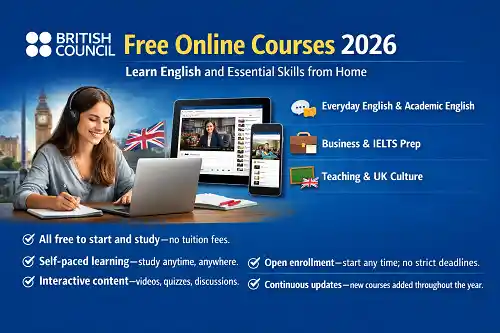
British Council Free Online Courses | Learn English and Essential Skills from Home. Apply for free online courses with certificates from here. The British Council is one of the world’s most respected providers of free online courses with certificate options, helping millions of learners across 200+ countries build real skills from the comfort of their homes. Whether you are just starting out or looking for professional certification to push your career forward, the British Council’s online learning platform offers structured programs in English language, digital skills, and creative industries that are recognized by universities and employers alike. These programs are an excellent opportunity for anyone seeking career advancement without the high costs associated with traditional education. If you are serious about using an online learning platform to transform your future, this guide covers everything you need to know about enrolling, studying, and benefiting from these globally recognized programs.
| Field | Details |
|---|---|
| Course or Program Name | British Council Free Online Courses (English, Digital Skills, Professional Development) |
| Platform or Provider | British Council via FutureLearn and official BC platforms |
| Eligible Participants | Open to learners worldwide, including students, professionals, and job seekers |
| Study Level | Beginner to Advanced (varies by course) |
| Certificate Type | Digital Certificate of Achievement (paid upgrade); Audit (free, no certificate) |
| Total Cost | Free to audit; paid certificate upgrades vary from $30–$200 depending on program |
| Application or Enrollment Deadline | Rolling enrollment — courses start regularly throughout the year |
| Official Website Link | www.britishcouncil.org | www.futurelearn.com |
Complete Benefits and What You Will Gain
Enrolling in British Council programs gives you access to high-quality content created by world-class educators and curriculum designers who understand what employers actually need. These courses are especially valuable because they combine education financing alternatives like partial scholarships and financial aid for online learners with practical skills training that leads to real job opportunities. For those who need extra support, many learners also access career coaching support through the British Council’s network of advisors and alumni mentors. The combination of trusted certification, flexible study, and professional guidance makes these programs one of the best investments you can make in yourself without spending a fortune.
| Benefit | Amount or Details |
|---|---|
| Certificate Validity Period | Lifetime — digital certificates do not expire |
| Job Market Recognition | Recognized by employers in 100+ countries |
| Salary Increase Potential | 10–35% salary increase reported by certified learners |
| LinkedIn Profile Value | Shareable credential link with issuer verification |
| University Credit Transfer | Available for select courses through partner universities |
| Alumni Network Access | Access to global British Council alumni community |
| Career Support and Job Placement | Varies by program; some include direct employer connections |
| Employer Recognition Level | High — especially in English-speaking and international markets |
Students who cannot afford the full cost of a paid certificate should know that there are several practical ways to cover the expense. Many learners take advantage of online course payment plans that allow them to spread costs over several months, while others explore income share agreements offered by third-party scholarship programs. If you are currently employed, it is worth asking your employer about tuition reimbursement programs, as many companies now actively invest in their employees’ professional development. A growing number of learners also combine partial scholarship combinations from charities, NGOs, and government schemes to make paid certification completely affordable without taking on debt.
Why You Need a Career Coach or Education Advisor Before Enrolling
Before you invest your time and money into any online course, working with a qualified career coach or education advisor can save you from some of the most common and costly mistakes that learners make every year. Studies consistently show that learners who receive guidance before enrolling have significantly higher completion rates and are more likely to apply their certification to a real job outcome within six months. Career counselors are trained to help with course selection based on your background, goals, and job market realities, and they can also support you with resume writing after certification to ensure your new skills are presented in the most competitive way possible. A good advisor will also help you build a job placement plan so that from day one of your studies, you already have a career roadmap that connects your learning directly to real employment opportunities.
Many learners today hire professional development consultants specifically to avoid wasting time on the wrong courses or spending money on certificates that are not valued by employers in their target industry. An online career coaching service can also help you with platform shortlisting so you are not overwhelmed by the hundreds of options available, as well as with application submission and LinkedIn optimization so your profile stands out to recruiters before you even finish your studies. Think of a career coach not as a luxury but as an investment that multiplies the return you get from every course you complete. The few hours you spend with an advisor at the beginning can save you months of misdirected effort later.
Available Study Programs and Specializations
The British Council and its partner platforms offer a remarkable range of programs that span technical careers, creative fields, business, and language development. Whether you are a fresh graduate looking for your first professional certification or an experienced professional wanting to pivot into a higher-paying sector, there is a program designed specifically for your situation. The courses below represent some of the most in-demand and highest-earning fields in today’s job market, and each one opens doors to both local employment and international remote work opportunities. Choosing the right specialization is a critical decision, and reviewing each area carefully will help you pick the path that best matches your long-term goals.
Data Science and Machine Learning
Data science is one of the fastest-growing fields in the world, with a global shortage of skilled professionals that employers are willing to pay premium salaries to fill. Courses in this area cover statistical analysis, Python programming, machine learning algorithms, and real-world data visualization. Certified data scientists earn between $70,000 and $130,000 annually in Western markets, and remote positions in this field are widely available on international job boards.
Web Development and Software Engineering
Web development courses teach the fundamentals of HTML, CSS, JavaScript, and full stack frameworks, giving students the skills needed to build professional websites and applications. A software engineering career is one of the most sought-after paths globally, and certified developers can find work as freelancers, remote employees, or in-office professionals in nearly every country. Programming courses online through trusted providers can significantly reduce the time it takes to break into this high-paying industry.
Digital Marketing and SEO
Digital marketing certification covers SEO, social media strategy, email marketing, Google Ads, and content creation — skills that every business in the world now desperately needs. This field is ideal for creatives and analytical thinkers alike, and the barrier to entry is relatively low compared to technical fields. Certified digital marketers can command salaries between $40,000 and $90,000 and often work remotely or as freelancers for international clients.
Cloud Computing and DevOps
Cloud computing certification is among the highest-paid digital credentials in the world today, with AWS certification cost being a common concern for learners who discover the massive return on investment it offers. DevOps engineers and cloud architects are in extreme demand as every major company moves its infrastructure online. Cloud computing professionals regularly earn six-figure salaries and enjoy some of the strongest job security in the technology sector.
Cybersecurity and Ethical Hacking
Cybersecurity courses online are in higher demand than ever as organizations around the world face increasing threats from hackers, ransomware, and data breaches. The ethical hacking course pathway trains learners to think like attackers so they can defend systems more effectively, and IT certification programs in this field are recognized globally by both private corporations and government agencies. Cybersecurity analysts with recognized certifications can start at $60,000 and quickly grow to six-figure earnings.
Business Analytics and Finance
Business analytics courses teach students how to use data to drive business decisions, improve processes, and forecast financial outcomes — skills that are valued in every industry from banking to healthcare. CFA level 1 prep and CPA exam prep courses are available on accredited platforms for those targeting the finance sector, and these credentials dramatically improve earning potential and promotion prospects. Business-focused professionals with analytical certifications typically earn between $55,000 and $100,000 depending on their industry and geography.
Project Management and Agile
Project management certification, particularly PMP certification online and Scrum master certification, is among the most universally valued credentials in the professional world today. Organizations across every sector need project managers who can deliver on time, on budget, and within scope, and certified PMs consistently earn above-average salaries. Six Sigma online training is also widely recognized and pairs well with project management credentials for professionals targeting operations roles.
Graphic Design and UI/UX
Graphic design and UI/UX courses cover creative tools, design principles, prototyping, and user research — skills that are directly applicable to freelancing, agency work, and in-house design roles. UX/UI designers are among the most in-demand professionals in the tech and media industries, with salaries ranging from $50,000 to $110,000 at senior levels. Creative professionals with strong portfolios supported by recognized digital certificates find it much easier to win high-paying clients on freelancing platforms.
Healthcare and Medical Coding
Healthcare online courses cover medical terminology, billing, coding standards like ICD-10, and patient management systems, preparing learners for administrative roles in hospitals, clinics, and insurance companies worldwide. Medical coding is a stable and growing field with strong demand for remote workers, making it an excellent choice for learners who want work-from-home careers without the lengthy time commitment of a clinical degree. Certified medical coders earn between $40,000 and $70,000 annually in the United States, with additional earning potential for experienced specialists.
Language Learning and Communication Skills
The British Council is world-renowned for its English language programs, which range from beginner foundations to advanced academic and professional English for specific industries. Strong communication skills are consistently rated by employers as one of the top traits they look for in candidates, and a British Council English certificate carries enormous credibility in international job markets. Language-certified professionals access a much wider pool of remote jobs, international contracts, and freelancing opportunities across global platforms.
Top Platforms Offering Free Courses with Certificates
Choosing the right online learning platform is just as important as choosing the right course, because not all platforms offer the same quality of instruction, employer recognition, or pathway to paid certification. The best online learning platforms combine high-quality content with verifiable credentials, career support tools, and active learning communities that help you stay motivated and on track. Many education consultants recommend that learners compare several platforms before committing to one, as differences in pricing, accreditation, and certificate value can be significant. Below are seven of the most trusted and widely recognized platforms available to global learners today.
Coursera
Founded in 2012 and headquartered in Mountain View, California, Coursera is one of the best platforms for online courses with content from over 200 universities and companies including Google, IBM, and Yale. The platform offers both free audit access and paid certificate upgrades, with Coursera paid certificate costs typically ranging from $49 to $300 per course. Financial aid is available for learners who cannot afford the full certificate cost, making it one of the most accessible accredited certificate programs online.
edX
edX was founded by Harvard and MIT in 2012 and offers university online courses at both introductory and advanced degree levels from institutions across the world. Free auditing is available for most courses, and professional certification upgrades typically cost between $50 and $300. edX also offers MicroMasters and Professional Certificate tracks that can count toward credit in full degree programs at partner universities.
FutureLearn
FutureLearn is the British Council’s primary partner platform and was founded in 2012 in London, offering courses from top UK universities and international institutions. Courses can be audited for free, and paid ExpertTrack or certificate upgrades are available at varying price points depending on program length and depth. Financial aid and scholarship options are available for eligible learners, particularly those from low-income countries.
Google Career Certificates
Google career certificates are among the most employer-recognized credentials available online, covering fields including data analytics, IT support, project management, UX design, and cybersecurity. Each program is fully online, self-paced, and takes approximately three to six months to complete at a cost of around $49 per month on Coursera. Google’s employer consortium actively connects certificate graduates with job opportunities, giving these credentials genuine job placement weight in the market.
LinkedIn Learning
LinkedIn Learning is headquartered in Sunnyvale, California and has been offering professional development content since 1995 through its predecessor Lynda.com. The platform offers over 16,000 courses with a monthly eLearning subscription plan, and all completed courses can be directly added to a LinkedIn profile, making it particularly powerful for professionals focused on LinkedIn profile optimization. A one-month free trial is available, and enterprise plans often include employer tuition reimbursement eligibility.
Khan Academy
Khan Academy was founded in 2008 in San Mateo, California and provides completely free courses with no paid certificate option, making it ideal for foundational learning before moving to certificate-bearing platforms. The platform covers mathematics, sciences, computing, economics, and SAT preparation with content suitable for all ages. Although Khan Academy does not offer paid certificates, it serves as an excellent free preparation tool before enrolling in formal certification programs on platforms like Coursera or edX.
MIT OpenCourseWare
MIT OpenCourseWare is a free and open publication of Massachusetts Institute of Technology course materials, launched in 2002 and covering over 2,500 courses from one of the world’s top engineering and science universities. No formal certificate is issued, but learners can use the materials to build real knowledge and supplement paid certification on other platforms. Completion of MIT OpenCourseWare content alongside a paid certificate from an accredited platform is a strategy many professional development consultants recommend for maximum credibility.
Harvard Online Learning
Harvard Online, part of one of the world’s most recognized universities, offers professional development courses, certificate programs, and online degree pathways across business, law, medicine, and liberal arts. Free audit access is available for many courses, while paid certificates range from $99 to over $2,000 depending on the program length and university credit attached. Financial aid is available for qualifying learners, and Harvard’s global name recognition means these certificates carry exceptional weight with employers worldwide.
How to Choose the Right Online Learning Platform
With hundreds of online learning platforms available today, choosing the wrong one is a genuine risk that costs learners both time and money every year. The most important thing to check before enrolling is whether the platform is an accredited certificate program provider or simply a content delivery site with no formal recognition behind it. Licensed online education providers partner with real universities or professional bodies, meaning their credentials are issued and verified by an institution that employers can look up. Learners should always verify digital credentials through the platform’s official certificate verification portal before paying for any upgrade, and they should research the platform’s reputation independently through reviews on sites like Trustpilot, Reddit, and Class Central.
Accreditation and University Partnership
The single most important quality of any online learning platform is whether its certificates are issued by or in partnership with a recognized educational institution. Accredited online degrees and certificates from university-partnered platforms carry far more weight with employers than certificates from unrecognized providers. Always check who is issuing the certificate — the platform itself or a partner university — before committing to a paid upgrade.
Transparent Pricing and Refund Policy
A trustworthy platform clearly lists all costs upfront, including the difference between free audit access and paid certificate options, without hiding fees in the checkout process. Online course payment plans and refund windows of at least seven days are standard features of legitimate platforms, and their absence is a red flag. If a platform demands full payment with no refund policy and vague pricing, look elsewhere immediately.
Instructor Credentials and Course Quality
The value of any certification depends heavily on the quality of instruction behind it, so always check the credentials of the instructors delivering the course material. Top platforms feature instructors who are university professors, industry practitioners, or certified experts with verifiable professional backgrounds. Reading student reviews from independent sites rather than the platform’s own testimonials page gives a much more accurate picture of the real learning experience.
Career Support and Job Placement Rate
The best platforms go beyond delivering content and actively support learners with job placement assistance, employer partnerships, and career coaching resources. Google Career Certificates, for example, publishes job placement statistics and operates an employer consortium that connects graduates directly with hiring companies. When comparing platforms, always ask what happens after you complete the course — a certificate without a pathway to employment is just a document.
Community and Peer Learning Network
Learning in isolation is one of the leading causes of course non-completion, and the best platforms invest heavily in peer discussion forums, live study groups, and mentorship networks that keep learners engaged. Platforms with strong community features typically see higher completion rates and better learning outcomes than those that deliver video content alone. Peer interaction also creates valuable professional networking opportunities that sometimes lead directly to job referrals and freelancing clients.
Technical and Enrollment Requirements
Enrolling in a British Council or partner platform course is generally straightforward, but there are a few technical and personal requirements you should confirm before you register to avoid any disruption to your studies. Many students use education consultants to help them navigate platform requirements, especially when enrolling in programs that include proctored exams, credit transfer pathways, or employer-verified certificates. Taking a few minutes to confirm you meet the technical requirements before you start will save you significant frustration later. The table below summarizes the most important requirements you should be prepared to meet.
| Requirement | Details |
|---|---|
| Internet Speed Required | Minimum 5 Mbps for video streaming; 10+ Mbps recommended |
| Device and Hardware | Laptop or desktop preferred; tablet or smartphone for reading only |
| Operating System | Windows 10+, macOS 10.13+, or ChromeOS (latest version) |
| Required Software or Apps | Modern browser (Chrome, Firefox, Safari); PDF reader; MS Office or Google Workspace |
| Language Proficiency Level | Basic English required for most courses; intermediate recommended for technical programs |
| Minimum Age Requirement | 13+ for most platforms; 18+ for certificate and financial aid programs |
| Educational Background Needed | None for most beginner courses; secondary school diploma for advanced programs |
| Payment Method Options | Credit/debit card, PayPal, Wise; bank transfer accepted on some platforms |
| Free Audit Availability | Yes — most courses allow free access to video content without certificate |
| Paid Certificate Cost | $30–$200 per course; monthly plans from $29–$99 on subscription platforms |
As you set up your home study environment, it is also worth thinking beyond just the course itself. Health insurance for remote workers and freelancers is something every self-employed learner should seriously consider once they begin transitioning away from traditional employment, as medical coverage gaps can be financially devastating. Additionally, investing in cybersecurity tools for online learning — such as a reliable VPN and a password manager — protects your personal data and study accounts from increasingly common online threats. Finally, a proper work from home setup with an ergonomic chair, good lighting, and a dedicated workspace makes a measurable difference in focus, productivity, and long-term physical health during extended study sessions.
International Student and Freelancer Health Insurance Guide
One of the most overlooked but genuinely important topics for anyone transitioning to remote work or freelancing after completing online certification is health insurance for freelancers and self-employed learners. Unlike traditional employees who receive employer-provided health plans automatically, remote workers and certified freelancers must actively seek out and fund their own coverage — and the cost of not having it during a medical emergency can be catastrophic. Fortunately, there are several types of plans available to international learners depending on their country of residence, employment status, and budget. These include private student insurance policies marketed directly to online learners, government health coverage options available in countries with national health systems, and international health insurance plans designed specifically for digital nomads and remote workers who cross borders frequently.
Monthly premiums for basic self-employed health insurance typically range from $50 to $250 depending on your country, age, and level of coverage, with more comprehensive plans covering dental, mental health services, emergency care, and prescription drugs costing $150 to $500 per month. Learners should always compare plans across multiple providers before purchasing to ensure they are getting the best health coverage for remote workers at a competitive price. Affordable insurance for online students is increasingly available through platforms and associations specifically designed for the freelancing economy, so it is worth checking whether your professional association, alumni network, or freelancing platform membership includes group insurance benefits at discounted rates.
Step-by-Step Enrollment and Certification Process
The process of going from interested learner to certified professional is simpler than many people think, but it does require careful planning and consistent follow-through to complete successfully. Most learners who fail to finish their courses do so not because the content is too hard, but because they never built a structured routine around their studies. This step-by-step guide walks you through every stage of the journey from first research to job application, giving you a clear and actionable roadmap to follow from day one. Following these steps in order significantly increases your chances of both completing the course and converting your certificate into a real career outcome.
Step 1 — Research and Shortlist Courses and Platforms
Start by identifying your career goal and working backwards to the specific skills and certifications that employers in that field are looking for. Use job boards like LinkedIn and Indeed to read real job postings in your target role and note which certifications appear most frequently in the requirements section. Once you know which certificates are in demand, compare the platforms that offer them and shortlist the two or three that have the best combination of accreditation, price, and career support resources available.
Step 2 — Check Eligibility and Prerequisites Carefully
Before enrolling, read the course prerequisites thoroughly to confirm you have the background knowledge required to follow the material comfortably. Some advanced courses assume familiarity with programming, statistics, or business fundamentals, and enrolling without that foundation leads to frustration and dropout. If you are unsure whether you qualify, many platforms offer a free preview of the first module so you can assess the difficulty level before committing.
Step 3 — Create Your Account and Enroll for Free
Creating an account on any of the major platforms takes only a few minutes using your email address and a secure password. Choose the free audit option first to access the course material and confirm that the content matches your expectations before paying for a certificate upgrade. If the course requires a paid enrollment upfront, check whether financial aid or a scholarship for online learners is available before entering your payment information.
Step 4 — Set a Weekly Study Schedule and Stick to It
Consistency is the single most important factor in online course completion, and the learners who succeed are almost always those who block out dedicated study time in their calendars every week. Aim for a minimum of five to ten hours per week depending on the course length and complexity, and treat your study blocks with the same seriousness as a work meeting or a class. Use a digital calendar, planner, or task management app to track your progress and hold yourself accountable to your schedule.
Step 5 — Complete All Video Lectures and Reading Materials
Work through the course content in the sequence provided by the instructors rather than skipping ahead or jumping between modules, as most courses are structured to build knowledge progressively. Take notes as you go using a note-taking app or a physical notebook, because active note-taking dramatically improves both retention and your ability to apply what you learn in real situations. Revisit any sections you found confusing rather than moving on, because gaps in foundational understanding tend to compound as courses advance.
Step 6 — Submit All Assignments and Hands-On Projects
Assignments and projects are not optional extras — they are where real learning actually happens, and many platforms require a minimum assignment submission rate to qualify for a certificate. Peer-graded projects in particular are valuable because they expose you to different approaches and force you to articulate your thinking clearly to other learners. Treat every project as a portfolio piece that you can show to future employers or clients, because a well-documented project library is often more persuasive than any certificate on its own.
Step 7 — Pass the Final Exam or Graded Quiz
Most certificate programs require passing a final assessment with a minimum score, typically between 70% and 80%, to qualify for the certificate of completion. Review your notes and revisit key modules before sitting the exam, and take advantage of any practice quizzes the platform offers to identify your weak areas before the actual assessment. Many platforms allow multiple attempts at exams, but spacing your attempts and studying between them gives much better results than retrying immediately after a failed attempt.
Step 8 — Download and Verify Your Certificate Online
Once you pass all requirements, your digital certificate is typically available to download within 24 to 48 hours through your platform dashboard or via a verification link sent to your registered email address. Before sharing your certificate with anyone, verify it yourself through the platform’s official verification portal to confirm that the credential ID is valid and the issuing institution is correctly listed. Keep both a digital copy in cloud storage and a printed copy for records, especially if you plan to submit it to universities or government agencies.
Step 9 — Add Certificate to Your LinkedIn Profile and Resume
Adding your certificate to LinkedIn immediately after downloading it is one of the highest-value actions you can take for your career, because recruiters actively search for candidates with specific credentials using LinkedIn’s certification filters. If you are not sure how to present your certificate most effectively, a professional resume writing service can help you frame your new skills in the language that hiring managers in your target industry respond to. LinkedIn profile optimization — including updating your headline, summary, and skills section to reflect your certification — can dramatically increase the number of profile views and recruiter messages you receive in the weeks following completion.
Step 10 — Apply for Jobs or Freelance Gigs Using Your New Certificate
With your certificate verified and your profile updated, it is time to actively pursue job opportunities through both traditional employment and the freelancing economy. Freelancing platforms for beginners like Upwork, Fiverr, and PeoplePerHour allow you to immediately start building a client base in your certified skill area, even before you have years of professional experience to show. Remote job boards like We Work Remotely, Remote.co, and FlexJobs regularly list positions specifically seeking candidates with online certifications, making them ideal hunting grounds for newly certified professionals transitioning to remote work careers.
Required Materials and Tools Checklist
Being properly prepared before you start your course makes the entire learning experience smoother, more enjoyable, and more productive from the very first day. Career coaches and education consultants consistently recommend that learners invest in the right tools and set up their study environment properly before enrollment rather than scrambling to sort things out after the course has already started. The checklist below covers everything you should have in place before you begin your first module, along with notes on why each item matters to your success.
| Item | Required or Optional | Important Notes |
|---|---|---|
| Laptop or Desktop Computer | Required | 8GB RAM minimum; 16GB recommended for technical courses |
| Stable Broadband Internet Connection | Required | Minimum 5 Mbps; fiber or cable preferred for video-heavy courses |
| Coursera or Platform Account | Required | Use a professional email address you check regularly |
| Valid Email Address | Required | All certificate links and notifications will be sent here |
| Payment Method for Certificate | Required (for paid certificate) | Credit card, PayPal, or Wise; apply for financial aid if needed |
| Government-Issued ID for Proctored Exams | Required (for proctored programs) | Passport or national ID; must match your registered name exactly |
| English Proficiency Proof (if required) | Optional (course-dependent) | IELTS, TOEFL, or Duolingo English Test scores may be requested |
| Portfolio Website or GitHub Profile | Optional (highly recommended) | Essential for tech and design students applying for jobs or freelance work |
| Updated LinkedIn Profile | Highly Recommended | Set up before starting so you can add the certificate the moment you finish |
| Resume or CV | Highly Recommended | Update it during the course so it is ready the day you receive your certificate |
| Letter of Intent for Degree Programs | Required (for degree pathways only) | A 300–500 word statement explaining your academic and career goals |
| Recommendation Letter (if applicable) | Optional (degree programs) | From a teacher, employer, or professional mentor who knows your work |
| Headphones and Webcam for Live Sessions | Required (for live programs) | A noise-cancelling headset and HD webcam improve the live session experience significantly |
| Note-Taking App or Digital Journal | Highly Recommended | Notion, Evernote, or Obsidian; active note-taking improves retention dramatically |
How to Pay for Courses and Certificates from Abroad
One of the most practical challenges international learners face is figuring out how to pay for online courses and certificate upgrades from their home country, particularly when dealing with currency conversion, international payment restrictions, and transfer fees. This is especially relevant for learners asking about tuition fee payment from Pakistan, India, Nigeria, Egypt, and other markets where local currency values make USD-priced courses feel expensive. Fortunately, several modern payment services have dramatically simplified the process of paying for online education across borders, and knowing how to pay for online courses from abroad using the right service can save you a meaningful amount of money through better exchange rates. The key is to compare payment methods before you commit to one, as the difference in fees between services can be 5% to 10% of the total amount — which adds up quickly if you are enrolling in multiple courses or long programs.
Wise (formerly TransferWise) is consistently the top recommended service for international tuition payments because it uses the real mid-market exchange rate with low transparent fees, often saving learners 3% to 8% compared to traditional bank transfers. PayPal student payment is widely accepted on major platforms and offers a familiar interface for those already using it for online shopping, though its exchange rates are typically less favorable than Wise by 1% to 3%. Western Union education payment services are also available for learners in markets where other digital payment options are limited, though fees can range from 2% to 5% depending on the destination and payment method. Standard international wire transfer for tuition is accepted on some platforms, particularly those affiliated with universities, but bank transfer fees can range from $15 to $50 per transaction in addition to less favorable exchange rates, making it the most expensive option for smaller course purchases.
Eligibility Criteria for Enrolling in These Courses
British Council and partner platform courses are designed to be as inclusive as possible, with most programs genuinely accessible to learners from all walks of life regardless of their country, background, or previous education level. That said, some programs do have specific eligibility criteria that you should verify before investing time in the application process to avoid disappointment. Understanding who qualifies for which type of program — and what accommodations are available for those who do not meet standard requirements — is an important step that many learners skip. The sections below break down each eligibility area clearly so you can quickly assess your own qualification status.
Nationality and Country of Residence
The vast majority of British Council and partner platform courses are open to learners from all countries worldwide without nationality restrictions. Some government-funded scholarship programs associated with these courses may be limited to specific regions or countries, so always read the scholarship terms carefully before applying. Learners from sanctioned countries may face payment restrictions but can often access free audit content without any geographical limitation.
Minimum Educational Qualification
Most introductory and intermediate level courses have no formal educational prerequisite and are open to anyone with the motivation to learn. Advanced and professional courses may recommend or require at least a secondary school education, and degree-linked programs typically require a bachelor’s degree or equivalent for enrollment. However, many platforms explicitly state that life experience and professional background can substitute for formal educational credentials in non-degree programs.
Language Proficiency Level
Since most British Council and partner platform courses are delivered in English, a basic to intermediate level of English comprehension is necessary to follow lectures, read materials, and complete written assignments. For English-specific programs, the British Council itself provides placement tools to help learners identify which level is most appropriate for their current ability. Non-English speaking learners can often find the same courses with subtitles in other languages on platforms like Coursera and edX, which helps bridge the initial language gap.
Minimum Age Requirement
Most platforms set a minimum age of 13 years for account creation, in line with international child data protection laws, but most certification programs are designed for learners aged 18 and above. Financial aid programs, payment processing, and proctored exams almost universally require learners to be at least 18 years old due to legal and contractual reasons. Younger learners can typically access free educational content with parental consent but may need to wait until they are 18 to claim a paid certificate.
Technical Prerequisites If Any
Technical courses like coding bootcamp programs, cloud computing certifications, and data science courses may assume some baseline familiarity with computers, basic mathematics, or introductory programming concepts. These prerequisites are always listed clearly on the course enrollment page, and platforms often recommend specific free preparation courses to take before enrolling in the main program. Completing the recommended preparatory content before the main course significantly reduces the risk of feeling overwhelmed and dropping out early.
Financial Eligibility for Aid Programs
Financial aid for online courses is typically available based on demonstrated financial need, and the application process involves submitting a brief explanation of your financial situation and why you need assistance. Coursera’s financial aid program, for example, approves the majority of applications submitted with a sincere and complete explanation, and approved learners receive access to the full paid certificate experience at no cost. Scholarships for online learners offered by external organizations often have more specific criteria around field of study, country of origin, and career goals.
Gap in Education or Career Policy
Online platforms are notably more flexible than traditional universities when it comes to gaps in education or career history, and most do not require any explanation for periods when you were not studying or working. This makes them particularly valuable for career changers, parents returning to work, people who have been unwell, and individuals in regions with limited access to traditional educational infrastructure. Your current motivation and commitment to completing the course matter far more to online platforms than your past academic trajectory.
Health and Device Requirements for Proctored Exams
Programs that include proctored exams require learners to have a functioning webcam, microphone, and a distraction-free environment at the time of the exam. Some proctoring software also requires a specific operating system version or browser, and certain platforms do not support Linux-based systems for proctored sessions, so checking compatibility before the exam date is essential. Learners with disabilities or health conditions that affect test-taking ability can contact most platforms in advance to request reasonable accommodations including extended time or alternative formats.
Official Course and Platform Websites
Always access online courses and certificate programs through official and verified websites only, as fraudulent copycat sites are a growing problem that puts your personal data and financial information at risk. The table below lists the official websites of the most trusted platforms discussed in this article so you can bookmark them directly and avoid confusion with unofficial lookalike sites.
Certificate Verification and Avoiding Fake Platforms
The rise of online education has unfortunately brought with it a rise in fraudulent platforms that issue worthless certificates to unsuspecting learners who spend real money expecting real credentials. Before enrolling in any online program, it is essential to verify that the platform is legitimate, the issuing institution is real, and the certificate can actually be verified by employers and universities through an official system. Career coaches and education consultants who work with learners on platform selection regularly encounter cases where a student paid for a certificate that no employer would accept because it came from an unaccredited or outright fake provider. The following eight-step verification process will help you avoid this situation entirely.
Step 1 — Find the Official Certificate Verification Portal
Every legitimate platform publishes a public verification tool, usually accessible without login, where anyone can check the validity of a certificate using the credential ID or URL provided on the certificate itself. Look for this tool on the platform’s official website under sections labeled “Credentials,” “Verify,” or “Certificates.” If a platform does not have a public verification portal at all, treat that as a serious warning sign about its legitimacy.
Step 2 — Enter Your Certificate ID or Credential URL
Using the verification portal, enter the unique certificate ID or paste the full credential URL that appears on your digital certificate. The portal should immediately return results confirming the learner’s name, completion date, course title, and the name of the issuing institution or partner university. If the ID returns no results or an error message, contact the platform’s support team before assuming anything — sometimes there are processing delays after certificate issuance.
Step 3 — Check the Issuer Name and Partner University
A legitimate certificate clearly identifies who issued it — either the platform itself (for platform-branded certificates) or the partner university or company (for co-issued credentials). Verify that the issuing institution’s name on the certificate matches a real, searchable organization that exists independently of the online platform. Certificates that list vague, unverifiable, or suspiciously generic institution names should be researched further before being used in job applications.
Step 4 — Confirm MOOC Platform Accreditation
Check whether the MOOC platform itself holds any formal recognition from regional or national educational authorities, or whether it partners with accredited universities that lend their accreditation to specific programs. Sites like Class Central, QS Rankings, and Times Higher Education publish reliable information about platform credibility and rankings. Beware of platforms that claim to be “accredited” without specifying the name of the accrediting body.
Step 5 — Share Verified Credential Link on LinkedIn
After verifying your certificate, add it to your LinkedIn profile using the platform’s official “Add to Profile” button if available, which creates a verifiable link that any recruiter can click to confirm its authenticity. Having a verified credential link on LinkedIn rather than just a text entry dramatically increases the credibility of your profile in the eyes of employers and headhunters. This step also protects you from false accusations of credential fraud because the verification is automatic and publicly accessible.
Step 6 — Report Fake or Suspicious Certificates
If you encounter a platform issuing certificates that cannot be verified, or if you suspect your certificate has been fraudulently duplicated, report it to both the platform and to consumer protection organizations in your country. Platforms like Coursera and edX take certificate fraud extremely seriously and maintain dedicated teams to investigate and resolve such incidents. Reporting fake platforms also protects future learners from being misled by the same operators.
Step 7 — Check Platform Legitimacy Through Independent Reviews
Before enrolling, spend at least 20 minutes reading reviews of the platform on independent sites like Trustpilot, Reddit communities like r/OnlineLearning, and Class Central’s course review database. Pay attention to complaints about certificate validity, customer service responsiveness, refund policy enforcement, and whether graduates have successfully used their certificates in real job applications. Platforms with overwhelmingly positive reviews from verified learners on multiple independent sites are generally the safest choices.
Step 8 — Confirm Certificate Value with Employers
The ultimate test of any certificate’s value is whether real employers in your target industry recognize and respect it. Before completing a paid program, search for the certificate name in LinkedIn job postings or ask in industry-specific online communities whether hiring managers in that field actively look for it. If experienced professionals in your field confirm that the certificate is respected and useful, that is the most reliable signal of its genuine career value.
A note on digital badge verification: Many platforms now issue Open Badges alongside certificates, which are verifiable digital credentials that contain embedded metadata including the earner’s name, the issuing organization, the criteria for earning the badge, and the issue date. These badges can be verified by clicking or scanning them, and they provide a higher level of authentication than a static PDF certificate because the data is cryptographically embedded in the badge itself.
Common Mistakes Students Make That Waste Time and Money
Career coaches and education consultants see the same costly mistakes repeated by online learners year after year, and understanding these patterns before you start is one of the most valuable things you can do to protect your time and investment. Most of these mistakes are completely avoidable with a small amount of upfront research and honest self-reflection about your goals and study habits. The eight mistakes below represent the most common traps that even motivated and intelligent learners fall into when navigating the world of online education. Being aware of them puts you miles ahead of the typical first-time online learner.
Enrolling Without Checking Certificate Validity
Many learners enroll in courses and pay for certificates without first verifying whether those certificates are recognized by employers in their target industry or region. A certificate from an unrecognized platform might cost $50 to $200 and take months to earn, but if no employer in your field has heard of the issuing platform, it adds zero value to your resume. Always Google the certificate name alongside “employer recognition” and “worth it” before paying for anything.
Signing Up on Fake or Unaccredited Platforms
The internet is full of platforms that look professional but offer certificates with no real educational or professional value behind them. Fake platforms often use impressive-sounding names, stock photos of classrooms and professors, and vague claims about “global accreditation” that cannot be independently verified. If a platform is not listed in major course directories like Class Central and cannot demonstrate a genuine university or professional body partnership, it is not worth your money.
Taking Too Many Courses Without Completing Any
The most common and most expensive form of procrastination in online learning is enrolling in multiple courses simultaneously without finishing any of them. This behavior, sometimes called “course collector syndrome,” leads to a dashboard full of incomplete courses and no certificates to show for the time and money spent. Commit to completing one course fully before beginning the next, and your completion rate and career outcomes will improve dramatically.
Skipping Assignments and Peer-Graded Projects
Assignments and peer-graded projects are not administrative formalities — they are the primary mechanism through which real learning is consolidated and applied. Learners who watch video lectures without completing the associated assignments consistently report that they cannot apply what they “learned” in real work situations because passive viewing without active practice does not build usable skills. Completing every assignment also ensures you are eligible for your certificate and have portfolio pieces to show future employers or clients.
Not Building a Portfolio Alongside Certifications
A certificate tells an employer you completed a course; a portfolio shows them what you can actually do with the skills you learned. In fields like web development, graphic design, data science, and digital marketing, a strong portfolio of real projects is frequently more persuasive to hiring managers than any number of certificates. Start building your portfolio from your very first course project, and by the time you finish, you will have concrete evidence of your capabilities that no certificate alone can provide.
Missing Out on Financial Aid and Scholarship Options
Millions of learners pay full price for certificates every year without realizing that financial aid for online courses and scholarship programs could have covered the entire cost for free. Coursera alone approves tens of thousands of financial aid applications annually, and the process takes only 10 to 15 minutes to complete. If you cannot comfortably afford a paid certificate, always apply for financial aid before giving up on the program or entering debt.
Ignoring Community Forums and Networking Opportunities
The networking value of online course communities is consistently underestimated by learners who view the discussion forums as optional extras rather than core features of the educational experience. Many learners have found job opportunities, freelancing clients, co-founders, and long-term mentors through the peer communities attached to online courses on Coursera, edX, and FutureLearn. Making yourself visible and helpful in course discussion forums is a simple habit that consistently pays dividends far beyond the course itself.
Not Updating LinkedIn and Resume After Completion
Completing a course and doing nothing with the certificate afterwards is the online education equivalent of buying expensive running shoes and leaving them in the box. Your certificate has zero career value sitting in a downloads folder — it only works when employers and recruiters can see it on your LinkedIn profile and resume. Update both within 24 hours of receiving your certificate, and set a reminder to share your achievement with your network through a post, which consistently generates engagement, recruiter messages, and new professional connections.
Salary Expectations After Completing Free Certificates
One of the most important questions learners ask before investing time in an online certification is what it will actually do for their income, and the answer depends heavily on which field you certify in and how effectively you market your new skills. In general, certified professionals consistently earn more than their uncertified peers across virtually every industry, and the gap tends to widen with experience. Free certificates from globally recognized platforms like Google, Coursera, and the British Council carry genuine market value that translates into real salary increases for people who use them proactively. The salary ranges below reflect current market data for entry-level to mid-career professionals in each field, combining both in-office and remote work salary figures from major markets.
Software Developer
Entry-level software developers with recognized certifications typically earn between $55,000 and $80,000 annually in Western markets, with remote work salary for developers often matching or exceeding in-office rates due to global demand. Mid-career software engineers with three to five years of experience and strong portfolio projects regularly earn between $90,000 and $140,000, with senior roles exceeding $160,000 at major technology companies. The global freelancing income potential for developers is equally strong, with experienced freelancers on Upwork and Toptal charging $50 to $150 per hour for specialized skills.
Data Scientist
Data science certification opens doors to one of the highest-paid technical career paths available today, with entry-level data scientists earning between $70,000 and $95,000 in their first roles. Mid-career data scientists with specializations in machine learning or AI earn between $110,000 and $150,000, and the demand for these skills continues to far outpace supply globally. Freelancing income potential in data science is also exceptional, with projects ranging from a few hundred to several thousand dollars depending on complexity and scope.
Digital Marketing Specialist
Digital marketing specialists with certifications in Google Analytics, HubSpot, and Facebook Ads typically start at $40,000 to $60,000 in full-time roles, with senior specialists and strategists earning between $70,000 and $100,000. Remote work salary for digital marketers is highly competitive because companies can hire globally for these roles without significant quality loss compared to in-person positions. Freelancing income in digital marketing is particularly strong for specialists who combine multiple certifications into a full-service offering for small and medium businesses.
Cloud Engineer
Cloud engineering is one of the highest-paid certification tracks in the entire technology sector, with entry-level cloud engineers earning between $75,000 and $100,000 and mid-career professionals regularly exceeding $130,000 to $170,000. AWS, Azure, and Google Cloud certifications are recognized by virtually every major technology employer in the world, and certified cloud professionals face extremely low unemployment rates due to the severe global shortage of these skills. Remote tech salary expectations for cloud roles are particularly strong, as most cloud infrastructure work can be performed entirely online.
Cybersecurity Analyst
Cybersecurity is one of the fastest-growing and most stable career paths in technology, with entry-level analysts earning between $60,000 and $85,000 and mid-career professionals reaching $100,000 to $140,000 annually. The global demand for cybersecurity talent far exceeds the available supply, meaning certified professionals rarely struggle to find employment and can negotiate salaries and remote working conditions confidently. Freelancing in cybersecurity through penetration testing, security auditing, and consulting can generate income of $100 to $300 per hour for experienced practitioners.
UX/UI Designer
UX and UI designers with strong portfolios and recognized digital certificates typically earn between $50,000 and $80,000 at entry level, with senior designers earning between $90,000 and $130,000 at technology companies and design agencies. Remote work is extremely common in design, and many UX/UI professionals build entire careers as freelancers working simultaneously with multiple international clients. The combination of design certification and a polished portfolio on Behance or Dribbble is the standard formula for breaking into this creative and financially rewarding field.
Project Manager
Project managers with PMP certification or Scrum master credentials earn between $65,000 and $90,000 at entry level, with experienced certified project managers in technology and construction sectors earning between $100,000 and $150,000. Project management is one of the most transferable careers available, with certified professionals finding opportunities across healthcare, technology, finance, government, and NGO sectors. Remote project management roles have become widely available since 2020, and certified PMs with strong communication skills are among the most in-demand remote professionals globally.
Career Pathways After Getting Your Certificate
Earning your certificate is the beginning of your career transformation, not the end — what you do with it in the weeks and months after completion determines whether it stays a document in your downloads folder or becomes the foundation of a completely different professional life. The good news is that certified learners today have more career pathways available to them than at any point in history, including freelancing, full-time remote employment, further academic study, entrepreneurship, public sector roles, and teaching. Using career coaching services to identify the pathway that aligns with your strengths, lifestyle goals, and financial targets is one of the smartest investments you can make at this stage. Each pathway below comes with practical entry steps, realistic income expectations, and honest advice about what it takes to succeed.
Freelancing
Freelancing is one of the fastest ways to start earning income from your new certification, and freelancing platforms for beginners like Upwork, Fiverr, and PeoplePerHour give you access to a global marketplace of clients from day one. Setting up your Upwork or Fiverr profile effectively requires a professional photo, a clear and specific service description, a competitive starting rate, and at least two to three portfolio samples that demonstrate your skills in action. Building a niche positioning — for example, specializing in “SEO content writing for SaaS companies” rather than just “writing” — consistently produces faster results and higher-paying clients than a broad generalist approach. Income from freelancing typically starts at $500 to $2,000 per month for beginners and scales to $5,000 to $15,000 or more per month as you build your reputation, and consulting a career coach experienced in freelancing market entry is strongly recommended before setting your rates and writing your profile.
Full-time Remote Employment
The market for full-time remote positions has expanded dramatically, and certified professionals today can compete for positions at remote-first companies based anywhere in the world through platforms like We Work Remotely, Remote.co, and LinkedIn’s remote job filters. Negotiating remote salary effectively requires research into market rates for your role across different geographies, because remote-first companies often pay location-adjusted salaries that still represent strong compensation in lower-cost countries. LinkedIn job search combined with direct outreach to hiring managers at companies whose culture and products genuinely interest you produces better results than simply applying to every job posting you find. Working with a career coach who specializes in remote job placement can significantly reduce the time it takes to land your first or next remote position.
Further Education
Many certified learners use their online credentials as a stepping stone to formal university education, taking advantage of credit transfer programs that convert completed MOOC courses into recognized university credit hours. Some universities, particularly those in the United States, United Kingdom, and Australia, actively promote pathways that allow learners to enter degree programs with advanced standing based on verified online certificates from platforms like Coursera, edX, and FutureLearn. Scholarships for certified learners are increasingly available at both undergraduate and postgraduate levels, and a strong collection of completed certificates demonstrates academic commitment in ways that admissions committees respond positively to. Consulting a professional education advisor before applying to degree programs ensures you choose the right institution, submit the strongest possible application, and take full advantage of any credit transfer opportunities available to you.
Entrepreneurship
Your certificate is not just a career credential — it is also a business license in the most practical sense, because it validates your expertise to potential clients, partners, and investors who might otherwise have no way to assess your capabilities. Starting an online business based on your certified skills — whether that means offering consulting, building digital products, creating online courses, or launching an agency — is one of the highest-potential pathways available to certified professionals today. Building a personal brand through consistent LinkedIn content, a professional blog, and a clear message about the problems you solve for specific types of clients is the foundation of sustainable online entrepreneurship. A career coach or professional development advisor with entrepreneurship experience can help you develop a business model, pricing strategy, and client acquisition plan that gets your new venture off the ground faster than trial and error alone.
Government and NGO Sector
Public sector organizations and international development bodies are increasingly recruiting digitally certified professionals for roles in digital transformation, data analysis, communications, and project management. International organizations like the United Nations, World Bank, and regional development banks actively seek candidates who combine field experience with recognized digital credentials, making online certificates genuinely valuable in this highly competitive sector. NGO tech positions in particular are growing rapidly as non-profit organizations modernize their operations and seek cost-effective technology solutions to scale their impact. Working with a career advisor who understands the specific recruitment processes of international organizations is particularly valuable in this pathway, as the application processes are often lengthy and highly specific in their requirements.
Teaching and Mentoring
Certified professionals who enjoy sharing knowledge can build a meaningful and well-paid career as online instructors, course creators, or mentors for the next generation of learners. Creating courses on platforms like Udemy, Teachable, or Skillshare allows you to package your certified knowledge and real-world experience into a product that generates passive income while helping others achieve the same transformation you went through. Becoming a mentor through platforms like MentorCruise, ADPList, or industry-specific coaching communities provides a more direct and often higher-value connection with learners who are willing to pay premium rates for one-on-one guidance. Consulting a career coach before launching your first course or mentoring service helps you position your offer correctly, set appropriate pricing, and market your expertise to the right audience from the very beginning.
Benefits of Free Online Learning for Global Learners
Free online learning has fundamentally changed who gets access to world-class education, and the British Council’s programs are a powerful example of how removing financial barriers to learning can transform individual lives and entire communities. The benefits extend far beyond simply acquiring new knowledge — they include career transformation, financial independence, international connections, and pathways to academic credentials that were previously inaccessible to millions of people. Whether you are in a rural village with a mobile internet connection or a major city with every resource available, the opportunity is essentially the same. The following eight benefits represent the most significant and lasting advantages that free online learning offers to global learners.
Globally Recognized Certificates from Top Universities
Earning a certificate from a top university through an online platform gives learners in developing markets access to credentials that were previously only available to those who could afford to live near and attend those institutions in person. Accredited certificate programs from Oxford, Harvard, MIT, and the British Council carry genuine employer recognition in international job markets, particularly in English-speaking and multinational employer environments. These credentials signal not just knowledge but the discipline, self-motivation, and digital literacy that modern employers increasingly prioritize over traditional degree credentials alone.
Zero Upfront Tuition with Financial Aid Options
The ability to audit courses completely free of charge removes one of the biggest barriers to education for learners in low and middle income countries, allowing anyone with internet access to begin learning from world-class instructors without any financial commitment. Financial aid for online courses means that even paid certificates are within reach for the majority of motivated learners regardless of income level, as approval rates for aid applications on major platforms are generally quite high. Education financing alternatives like income share agreements, employer tuition reimbursement programs, and partial scholarship combinations further expand access for those who want certified outcomes but are working within tight budgets.
Flexible Self-Paced Learning from Anywhere in the World
Self-paced online courses respect the reality that most adult learners have existing work, family, and community commitments that make rigid timetables impractical. The ability to study at 11pm after the children are asleep, or during a lunch break at a current job, makes continuing education genuinely accessible for people who would never be able to attend traditional classes. This flexibility also means that learners can progress faster than a traditional academic calendar would allow, potentially completing in three months what would otherwise take a full semester, which is particularly valuable for professionals in career transition who need new credentials quickly.
Direct Career Coaching and Job Placement Support
The best online learning platforms have moved far beyond simply delivering content and now offer genuine career coaching services, employer networking events, job fairs, and resume review tools as part of their certificate programs. Google Career Certificates includes direct connections to an employer consortium of hundreds of companies actively seeking certified graduates, a feature that blurs the line between education and professional development online in the most useful way possible. Learners who take full advantage of these career support resources consistently achieve better employment outcomes than those who only complete the course content without engaging with the surrounding career support ecosystem.
Access to World-Class Instructors and Course Content
Online platforms give learners in Pakistan, Nigeria, Indonesia, and Peru access to the same professors and industry experts who teach at Harvard, Stanford, and MIT — something that would have been unimaginable even fifteen years ago. The quality of instruction on the best platforms for online courses is consistently high because top institutions and companies invest significantly in the production quality and curriculum design of their online offerings, knowing that their global reputation is attached to every course they publish. Exposure to world-class thinking and teaching also has an indirect benefit of helping learners develop higher standards for their own work, which pays dividends throughout their career.
Networking with Professionals from 180+ Countries
The peer communities attached to major online courses include professionals from virtually every country in the world, creating networking opportunities that would be impossible to replicate at any in-person event or educational institution. Connecting with peers in other countries opens doors to international freelancing referrals, collaboration on projects, job recommendations, and friendships that sometimes span entire careers. In an increasingly remote and global economy, an international professional network built through shared learning experiences is one of the most durable assets any professional can develop.
Pathway to Accredited Degree Programs
Free online courses are no longer just standalone learning experiences — they are increasingly recognized as legitimate building blocks toward full accredited degree programs at universities around the world. Credit transfer pathways allow learners to convert completed MOOCs from platforms like edX, Coursera, and FutureLearn into university credit hours, reducing both the time and cost required to complete a formal degree. For learners in regions where university access is limited by geography, economics, or capacity constraints, this pathway represents a transformative alternative to the traditional model of higher education that was previously out of reach.
Full Integration with the Freelancing and Remote Work Economy
Online certificates are uniquely positioned as credentials for the freelancing and remote work economy because they demonstrate exactly the skills and self-discipline that clients and remote employers look for in candidates they will never meet in person. A learner who completes a self-paced online certification demonstrates time management, digital literacy, and self-motivation — qualities that are inherently difficult to fake and that matter enormously to employers managing distributed teams. The combination of a verified certificate from a recognized platform and a strong portfolio of completed projects is consistently the formula that certified professionals use to break into the global remote work economy and build sustainable independent careers.
Conclusion
The opportunity that British Council free online courses represent is genuinely significant — these programs give learners from every corner of the world access to internationally recognized education that can change the direction of their careers without requiring them to take on debt, relocate, or pause their current lives. Whether you are pursuing English language skills, digital marketing certification, cloud computing credentials, or project management qualifications, the combination of free access, flexible study, and globally respected certification makes this one of the smartest investments of time available to any motivated learner today.
Before you enroll, take the time to consult with a career coach or certified education advisor who can help you align the right course with your specific career goals and avoid the common mistakes that cause so many learners to waste months on programs that were never the right fit for them. Combining a free online course with certificate with proper career coaching, a LinkedIn optimization strategy, and a clear job placement plan is not just a better approach — it is the difference between a certificate sitting in a downloads folder and a credential that genuinely changes what you earn and how you work. The resources are available, the platforms are ready, and the only thing standing between you and your next chapter is the decision to begin — so start today, study consistently, and use every tool and advisor available to make your certification count.
Free online courses, certificate programs online, online learning platforms, career coaching, professional certification, education financing, student loan online courses, remote work tools, digital marketing courses, data science certification, tech career path, freelancing guide, study from home, online MBA programs, job placement assistance
CATEGORIES: Free Online Courses, Career Development, Digital Education
INTERNAL LINKING SUGGESTIONS:
- Google Career Certificates Complete Guide: How to Get Certified and Land a Remote Job in 2026
- Coursera Financial Aid Application Guide: How to Get a Free Certificate on Any Course
- Best Freelancing Platforms for Beginners: How to Get Your First Client After Certification
- Health Insurance for Freelancers and Remote Workers: A Complete Comparison Guide
- How to Pay for Online Courses from Pakistan, India, and Nigeria: Best International Payment Methods
British Council Free Online Courses | Learn English and Essential Skills from Home. In today’s competitive global education system, international students are constantly searching for affordable ways to improve their academic profile, increase their chances of getting fully funded scholarships, and meet student visa requirements for top countries like the United States, Canada, the United Kingdom, and Australia. One of the smartest and most effective ways to do this is by enrolling in British Council free online courses and other globally recognized platforms.
These courses not only help you improve your English language skills but also prepare you for study visa sponsorship opportunities, strengthen your immigration pathways, and enhance your eligibility for online degree programs and study abroad opportunities.
This detailed guide will explain everything you need to know about free online courses with certificates, how they can help you study abroad, and how to move from learning online to securing admission, scholarships, and even PR after study.
What Are British Council Free Online Courses?
British Council free online courses are high-quality learning programs designed to help students improve English language skills, communication, academic writing, and professional abilities. These courses are usually hosted on platforms like FutureLearn and are accessible worldwide.
They are especially valuable for students planning to apply for study visa sponsorship, as strong English skills are a key requirement for student visa applications in countries like Canada, Australia, the UK, and the USA.
Microsoft Free Online Courses with Certificates
These courses are:
- 100% online
- Free to access
- Designed by experts
- Recognized globally
- Ideal for academic and career growth
Why Free Online Courses Matter for Study Abroad
Many students think they must spend thousands of dollars to prepare for studying abroad. In reality, free online courses can significantly improve your chances of getting admission, scholarships, and even visa approval.
Here’s how they help:
- Improve your English proficiency for student visa requirements
- Strengthen your academic profile for fully funded scholarships
- Demonstrate commitment to learning in visa interviews
- Build high-income skills in IT, business, and healthcare
- Increase chances of admission to top universities
They also play an important role in building strong immigration pathways, especially for students planning long-term settlement or PR after study.
Course Summary (Quick Overview Table)
Below is a simple overview of typical British Council and similar free online courses:
Course Level: Beginner to Advanced
Platform: FutureLearn, Coursera, edX, Google, Microsoft, Meta
Duration: 2 weeks to 12 weeks
Certification: Free (optional paid certificate available on some platforms)
Eligibility: Open to all nationalities
Deadline: Open enrollment (apply anytime)
Mode: Fully online
Cost: Free (no tuition fee, no travel cost)
University of Adelaide Free Online Courses 2026 with Certificates | Apply Now!
Financial Benefits of Free Online Courses
One of the biggest advantages of these courses is the financial relief they offer to international students.
Key financial benefits include:
- No tuition fee
- No travel cost
- Free learning materials
- Flexible learning schedule
- Free or low-cost certificates
These benefits are especially helpful for students from developing countries who want to prepare for study abroad opportunities without financial stress.
Top Platforms Offering Free Online Courses with Certificates
Several global platforms provide free online courses that are highly recognized by universities and employers.
Coursera
- Offers courses from top universities
- Provides certificates that enhance your CV
- Ideal for IT, business, and healthcare fields
edX
- Founded by leading universities
- Offers academic and professional courses
- Supports online degree programs
FutureLearn
- Partnered with the British Council
- Focus on English and professional skills
- Ideal for beginners
- Offers career certificates in IT and digital marketing
- Highly valued by employers
Microsoft
- Provides courses in cloud computing and AI
- Helps build high-income tech skills
Meta
- Offers social media and marketing courses
- Useful for digital marketing careers
Open University Online Courses with Free Certificates
Study Fields You Can Learn Online
Free online courses cover a wide range of fields that align with global job demand.
Popular study fields include:
- Information Technology (IT)
- Business and Management
- Healthcare and Nursing
- Engineering
- Digital Marketing
- Data Science
- Artificial Intelligence
- Communication Skills
- English Language Training
These fields are also in high demand in countries like Canada, the USA, the UK, and Australia, increasing your chances of employment and PR after study.
Role of Education Consultants and Recruitment Agencies
Education consultants and international recruitment agencies play a key role in helping students move from online learning to studying abroad.
Top organizations include:
- IDP Education
- British Council
- ICEF
They help with:
- University selection
- Student visa requirements
- Application submission
- Scholarship guidance
- Immigration pathways
Working with these organizations can significantly improve your chances of securing study visa sponsorship.
Student Visa Requirements for Top Countries
Understanding visa requirements is essential for studying abroad.
Canada Student Visa Requirements
- Letter of acceptance from a recognized institution
- Proof of funds
- English proficiency (IELTS or equivalent)
- Statement of purpose
- Valid passport
Australia Student Visa Requirements
- Confirmation of enrollment (CoE)
- Proof of financial capacity
- English test results
- Genuine student requirement (GSR) statement
Free online courses can help strengthen your application and improve your chances of visa approval.
Open University Online Courses with Free Certificates
Step-by-Step Process: From Online Course to Study Abroad
Here is a practical roadmap for international students:
Step 1: Enroll in Free Online Courses
Choose courses related to your desired field.
Step 2: Complete Courses and Get Certificates
Add these certificates to your CV and LinkedIn profile.
Step 3: Prepare for English Tests
Use British Council courses to improve language skills.
Step 4: Search for Fully Funded Scholarships
Apply to universities offering scholarships.
Step 5: Apply to Universities
Submit your academic documents and certificates.
Step 6: Apply for Student Visa
Meet all student visa requirements.
Step 7: Attend Visa Interview
Show your learning journey and career goals.
Deakin University Free Online Course with Free Certificate
Required Documents Checklist
Before applying for study abroad opportunities, prepare these documents:
- Academic transcripts
- Passport copy
- English test scores
- Online course certificates
- Statement of purpose
- Letters of recommendation
- Financial proof
- CV/Resume
Eligibility Criteria for Free Online Courses
Most free online courses have simple eligibility requirements:
- No age restriction
- No academic limitation
- Basic internet access
- Willingness to learn
This makes them accessible to students from all backgrounds.
Embassy Application Guidance
When applying for a student visa, embassy officers evaluate your profile carefully.
Tips for success:
- Show strong academic background
- Highlight online certifications
- Explain your study plan clearly
- Demonstrate financial stability
- Prove your intention to return or follow legal immigration pathways
Common Mistakes to Avoid
Many students make avoidable mistakes during the process.
Avoid these:
- Ignoring English language preparation
- Submitting incomplete documents
- Choosing irrelevant courses
- Not researching visa requirements
- Applying late for scholarships
Career Opportunities and Salary Expectations
Free online courses can lead to high-paying jobs globally.
United States
- IT professionals: $80,000 – $120,000 per year
- Digital marketers: $60,000 – $90,000
Canada
- Software engineers: CAD 70,000 – CAD 110,000
- Healthcare workers: CAD 60,000 – CAD 100,000
These careers also support long-term immigration pathways and PR after study.
PR Pathways After Study
Many students aim for permanent residency after completing their studies.
Canada PR Pathway
- Post-Graduation Work Permit (PGWP)
- Express Entry system
- Canadian Experience Class
Australia PR Pathway
- Skilled Migration Program
- Temporary Graduate Visa
- Points-based system
Having strong skills and certifications increases your chances of success.
Deakin University Free Online Course with Free Certificate
Benefits of Free Online Courses for International Students
Free online courses offer multiple advantages:
- Improve academic profile
- Increase scholarship chances
- Strengthen visa applications
- Build job-ready skills
- Save money
- Learn from global institutions
They are a powerful tool for students who want to achieve their dream of studying abroad.
How Free Online Courses Boost Scholarship Chances
Scholarship committees look for motivated and skilled students.
Online courses help by:
- Demonstrating self-learning ability
- Showing commitment to education
- Providing relevant skills
- Strengthening your personal statement
This significantly increases your chances of winning fully funded scholarships.
High-Income Skills You Can Learn Online
To succeed globally, focus on high-demand skills:
- Coding and programming
- Data analysis
- Digital marketing
- Project management
- Healthcare skills
These skills are essential for jobs in top countries and support PR after study.
Final Thoughts
British Council free online courses and other global platforms offer an incredible opportunity for international students to improve their skills, prepare for study abroad opportunities, and achieve long-term career goals.
By combining online learning with proper planning, students can:
- Secure fully funded scholarships
- Meet student visa requirements
- Build strong immigration pathways
- Achieve PR after study
Start today, and take your first step toward a successful international education journey.
Best Free Online Courses for Jobs in the USA, UK, and Canada
Official Free Online Course Websites
Here are the official links to explore the courses:
Apply link for free online courses
Apply for Free Online Courses with Certificates
- British Council Courses on FutureLearn
- Coursera Free Online Courses
- edX Free Courses
- Google Career Certificates
- Microsoft Learn
- Meta Blueprint Courses
Official Course and Platform Websites
Always access online courses and certificate programs through official and verified websites only, as fraudulent copycat sites are a growing problem that puts your personal data and financial information at risk. The table below lists the official websites of the most trusted platforms discussed in this article so you can bookmark them directly and avoid confusion with unofficial lookalike sites.
| Resource Name | Official URL | Purpose |
|---|---|---|
| Coursera | www.coursera.org | University and industry certificate programs with financial aid |
| edX | www.edx.org | Harvard and MIT-founded platform for university-level online learning |
| Google Career Certificates | grow.google/certificates | Google-designed career certificates for tech and business roles |
| Harvard Online Learning | online.harvard.edu | Professional development and degree programs from Harvard University |
| MIT OpenCourseWare | ocw.mit.edu | Free access to MIT course materials in science, tech, and engineering |
| LinkedIn Learning | linkedin.com/learning | Professional development courses integrated with LinkedIn profile |
| FutureLearn | www.futurelearn.com | British Council partner platform with UK university courses |
| Khan Academy | www.khanacademy.org | Completely free foundational learning in maths, science, and computing |
Stay Connected!
Never miss a scholarship deadline! Join our channels for daily fully-funded opportunities & instant alerts.