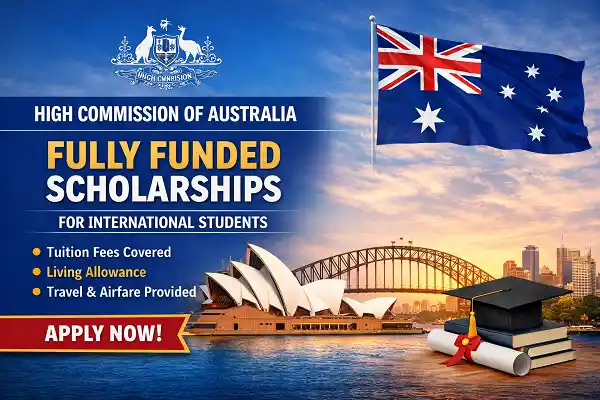
High Commission of Australia fully funded scholarship for international students. Apply for fully funded scholarships here. The High Commission of Australia offers one of the most prestigious fully funded scholarship programs available to international students seeking world-class education and a genuine immigration pathway.
This scholarship provides complete study visa sponsorship, covering tuition, living expenses, and more, making it one of the most competitive awards for students from developing nations. If you are a student from Pakistan, India, or any other eligible country, this is your chance to study in Australia without bearing the full financial burden. Understanding the details before you apply can significantly improve your chances of selection.
| Field | Details |
|---|---|
| Scholarship Name | Australia Awards Scholarships (High Commission of Australia) |
| Host Country | Australia |
| Eligible Nationalities | Citizens of eligible developing countries (Asia-Pacific, Africa, Middle East, South Asia) |
| Study Level | Undergraduate, Postgraduate (Masters, PhD) |
| Scholarship Type | Fully Funded (Government-Sponsored) |
| Funding Coverage | Tuition, living stipend, airfare, health insurance, and more |
| Application Deadline | Varies by country — typically April to June each year |
| Official Website | www.australiaawards.gov.au |
Complete Financial Benefits and Cost Breakdown
One of the most attractive aspects of this scholarship is how comprehensively it covers your cost of living and study in Australia, making it a genuine education loan alternative for students who cannot afford overseas education on their own. The program provides financial aid for international students in a way that few other scholarships can match, covering almost every expense from the moment you board the plane to the moment you graduate. For students weighing student finance options, this scholarship eliminates the need to worry about tuition, accommodation, or health coverage. The table below shows a detailed breakdown of what you receive.
| Benefit | Amount or Details |
|---|---|
| Full Tuition Fee Waiver | 100% tuition covered by Australian Government |
| Monthly Living Stipend | Approx. AUD 2,500 – AUD 3,000 per month |
| University Accommodation | Establishment allowance provided on arrival |
| Annual Return Airfare | Economy class return airfare from home country |
| Health and Medical Insurance | Overseas Student Health Cover (OSHC) fully paid |
| Research or Book Allowance | AUD 5,000 per year (for research students) |
| Visa Fee Reimbursement | Student visa application fee reimbursed |
| Family Allowance | Available for eligible dependents in some cases |
Students who do not secure this full award can also explore international student loans from banks like Habib Bank or National Bank of Pakistan, education financing partnerships offered by Australian universities, and partial scholarship combinations to cover any remaining costs while studying in Australia.
Why You Need an Immigration Consultant or Education Advisor
Applying for a scholarship and student visa to Australia is not a simple process, and working with a qualified immigration consultant or education advisor can genuinely improve your chances of a successful outcome. An experienced immigration lawyer can assist with visa rejection appeals, document verification, and PR pathway planning, saving you from costly mistakes that could delay your study plans by an entire year. Many students hire student visa consultants specifically to ensure their documents are correctly organized, their financial evidence is presented properly, and their motivation letters are genuinely compelling. An international student recruitment agency can take care of university shortlisting, application submission, and even the visa filing process so you focus on preparing academically. Whether you are applying from Lahore, Karachi, or a smaller city, getting professional guidance from a certified advisor is one of the smartest investments you can make in your future.
Available Study Programs for International Students
Australian universities offer an incredibly diverse range of programs, and this scholarship covers most fields of study at both postgraduate and undergraduate levels. From cutting-edge technology programs to social sciences and healthcare, students can find their ideal course at a world-ranked institution. The scholarship selection committee looks for applicants who choose programs that align with Australia’s development priorities and their home country’s needs. Below are ten high-demand study programs available to scholarship recipients.
Computer Science and Artificial Intelligence
Australia is rapidly growing its tech sector, making computer science and AI one of the most in-demand programs for international students. Graduates from Australian universities enter a job market where software developers earn an average of AUD 90,000 to AUD 130,000 per year. The demand for AI specialists is particularly high, with companies actively sponsoring skilled worker visas for qualified graduates.
Medicine and Healthcare
Medical degrees from Australian institutions carry global recognition and open doors to well-paying careers in Australia, the UK, Canada, and beyond. The average salary for a registered nurse in Australia starts at around AUD 70,000 annually, while doctors can earn well above AUD 150,000. The healthcare sector consistently ranks among the highest in job demand for post-study work visa holders.
Business Administration and MBA
An MBA from an Australian university equips students with global management skills and strong networking opportunities. Business graduates are among the highest earners, with starting salaries averaging AUD 80,000 to AUD 110,000 in corporate roles. This degree also strengthens your profile for skilled worker visa applications after graduation.
Civil and Mechanical Engineering
Australia’s infrastructure boom means civil and mechanical engineers are in constant demand, and many employers offer sponsorship to skilled international graduates. Starting salaries for civil engineers typically range from AUD 75,000 to AUD 95,000 per year. A degree in this field is also a strong foundation for permanent residence application through skilled migration pathways.
Law and International Relations
Australian law degrees are internationally respected and prepare students for careers in corporate law, international policy, and legal consulting. Law graduates with Australian qualifications can earn between AUD 80,000 and AUD 150,000 depending on their specialization. Many alumni pursue further study or work in international organizations after completing their degrees.
Environmental Science and Sustainability
With climate change at the forefront of global policy, environmental scientists are among the most sought-after professionals in Australia. Graduates work in government agencies, mining companies, NGOs, and research institutions, with salaries starting at around AUD 65,000. This field also opens doors to state nomination under skilled migration programs.
Data Science and Analytics
Data science is one of the fastest-growing disciplines globally, and Australian universities offer world-class programs in this field. Graduates are hired by banks, technology firms, healthcare providers, and government agencies, with average salaries exceeding AUD 100,000. Data analysts and machine learning engineers consistently rank among the most in-demand roles on post-study work visa lists.
Education and Teaching
Australia faces a significant teacher shortage, particularly in rural and regional areas, making qualified graduates highly attractive to employers. Education graduates can earn between AUD 70,000 and AUD 90,000 per year, with strong job security. A teaching qualification also provides a smooth entry point into the state nomination pathway for permanent residence.
Architecture and Urban Planning
As Australian cities continue to expand, architects and urban planners are in high demand for both government and private sector projects. Graduates can expect starting salaries of AUD 70,000 to AUD 90,000 in major cities like Sydney and Melbourne. This degree is recognized internationally and supports a clear pathway to skilled worker visa sponsorship.
Economics and Finance
Economics and finance graduates from Australian universities are highly sought after in banking, investment management, and government roles. The average salary for a financial analyst in Australia starts at AUD 75,000 and grows quickly with experience. With a finance degree, graduates often qualify for employer-sponsored work permits and can accumulate points for permanent residence applications efficiently.
Top Universities in Australia for International Students
Australia is home to some of the world’s most prestigious universities, and many of them actively support international students through dedicated support services and generous scholarship programs. University admission consultants can help you identify the right program, improve your personal statement, and meet all application deadlines with confidence. Below are seven top universities that regularly host scholarship recipients and international students.
The University of Melbourne
Located in Melbourne, this university consistently ranks in the top 50 globally. The acceptance rate for international students is around 35 to 40 percent. Tuition fees range from AUD 35,000 to AUD 50,000 per year, and multiple scholarship opportunities are available, including Australia Awards placements.
The Australian National University (ANU)
Based in Canberra, ANU is Australia’s top-ranked university and a frequent host for Australia Awards scholars. International student acceptance rates vary by program but are generally competitive. Tuition ranges from AUD 36,000 to AUD 49,000 per year, and ANU has dedicated international scholarship offices.
University of Sydney
The University of Sydney is one of Australia’s oldest and most respected institutions, located in the heart of Sydney. It accepts international students across hundreds of programs, with tuition fees between AUD 37,000 and AUD 55,000 per year. The university actively partners with the Australia Awards program and has extensive student support services.
University of Queensland (UQ)
Situated in Brisbane, UQ is consistently ranked among the world’s top 100 universities. Tuition fees range from AUD 32,000 to AUD 48,000 annually, and the acceptance rate for international students is relatively accessible. UQ offers several internal scholarships alongside the Australia Awards program.
Monash University
Monash is one of Australia’s largest universities, with campuses in Melbourne and internationally. It is particularly popular among Pakistani and South Asian students due to its strong academic reputation and diverse community. Tuition fees range from AUD 30,000 to AUD 45,000 per year, with scholarships available at all levels.
University of New South Wales (UNSW)
UNSW Sydney is a world leader in research and technology programs, particularly in engineering and computer science. International students make up a significant portion of the student body, with acceptance rates varying between 40 and 60 percent by department. Tuition fees start at AUD 35,000 per year, and the university has an active scholarship office.
University of Adelaide
Part of the prestigious Group of Eight, the University of Adelaide is an excellent choice for students pursuing sciences, engineering, and health programs. It has a relatively high acceptance rate for international students compared to other Group of Eight universities. Tuition ranges from AUD 29,000 to AUD 44,000 per year, and it regularly hosts Australia Awards scholarship holders.
How to Choose the Right Education Consultant for Australia
Choosing the right education consultant is one of the most important decisions you will make in your journey toward studying in Australia, and a wrong choice can lead to a visa rejection, lost application fees, and wasted years. A genuine education consultant should be registered with a recognized professional body, have verifiable experience with Australian university applications, and be transparent about their fee structure from the beginning. Unfortunately, there are many unqualified or fraudulent agents operating in countries like Pakistan, and students who use fake consultants frequently face document forgery issues that result in permanent visa bans. Always look for registered immigration consultants, licensed education agencies, and certified visa consultants who can show a documented success rate and real student testimonials. Here are five qualities that distinguish a trustworthy education consultant.
MARA or Equivalent Certification
In Australia, registered migration agents must be certified with the Migration Agents Registration Authority (MARA). For consultants based in Pakistan or other countries, look for those affiliated with recognized international education networks or Australian embassy-approved agencies. Certification is your first and most important filter.
Transparent Fee Structure
A legitimate education consultant will tell you exactly what you are paying for, including application fees, visa filing charges, and consultation costs. Be wary of anyone who asks for large upfront payments without a written service agreement. Transparency protects you legally and financially throughout the process.
Documented Success Rate
Ask the consultant for verified data on how many students they have successfully placed in Australian universities and how many have received visas without rejection. A reliable consultant will not hesitate to share this information. Low success rates or vague answers are red flags.
Post-Visa Support
The best consultants do not disappear after your visa is approved. They help you with pre-departure orientation, student accommodation bookings, and relocation support in Australia. This level of care indicates a consultant who genuinely invests in your success.
Embassy and University Network
An experienced consultant maintains direct communication channels with universities and understands how Australian embassies process student visa applications. This network allows them to resolve issues quickly and give you accurate, up-to-date information.
Student Visa Requirements for Australia
Applying for a student visa to Australia requires careful preparation, and even small errors in documentation can lead to delays or outright rejection. Many students use student visa consultants specifically to navigate the Australian Department of Home Affairs requirements with confidence and accuracy. The Australian student visa, known as the Subclass 500 visa, has strict financial, medical, and language requirements that must be met before approval. The table below outlines everything you need to prepare.
| Requirement | Details |
|---|---|
| Visa Type and Name | Student Visa (Subclass 500) |
| Proof of University Admission | Confirmation of Enrolment (CoE) from Australian institution |
| Proof of Financial Funds | Bank statements covering tuition + AUD 21,041 living costs per year |
| Valid Passport Validity | Must be valid for the full duration of your study |
| Medical Examination Certificate | Required from a DIBP-approved panel physician |
| Language Proficiency Test Score | IELTS minimum 6.0 overall (varies by institution) |
| Biometric Enrollment | Required at Visa Application Centre in your country |
| Visa Application Fee | AUD 710 (approximately PKR 260,000 at current rates) |
| Average Processing Time | 4 to 6 weeks (can be longer during peak periods) |
| Health Insurance Requirement | Overseas Student Health Cover (OSHC) mandatory for full visa duration |
International student health insurance in the form of OSHC is a non-negotiable requirement for the Australian student visa, and students should carefully compare student insurance plans from providers like Medibank, BUPA, AHM, and NIB before completing their visa application to find the most affordable and comprehensive coverage.
International Student Health Insurance Guide
Health insurance for international students is not optional in Australia — it is a legal requirement tied directly to your student visa conditions, and failing to maintain it can result in visa cancellation. The Australian government mandates Overseas Student Health Cover for all international students, and this must remain active for the entire duration of your enrollment. Students can choose from university health plans negotiated at group rates, private student insurance providers such as Medibank or BUPA, or government-affiliated health coverage programs. Monthly costs for OSHC typically range from AUD 40 to AUD 65 per month for a single student, depending on the provider and level of coverage. When comparing plans, look for the best health coverage for students abroad, paying attention to whether the plan includes dental treatment, mental health consultations, emergency evacuation, and prescription medications, as these are often the most frequently needed services. Meeting the medical insurance requirement for a study visa is straightforward, but choosing the right plan with comprehensive benefits is what protects your health and finances throughout your stay. Affordable insurance for international students is widely available, and applying early is always advisable.
Step-by-Step Scholarship and Study Visa Application Process
The process of applying for an Australian scholarship and student visa involves multiple stages, each requiring careful attention to detail and timely action. Starting early — ideally 12 to 18 months before your intended intake — gives you enough time to gather documents, prepare language tests, and submit a strong application. Missing any single step can cost you an entire academic year. Follow this ten-step guide carefully to maximize your success.
Step 1: Research and Shortlist Scholarships
Begin by thoroughly researching all available Australian government and university-level scholarships for your nationality and field of study. The Australia Awards website, individual university portals, and your local Australian High Commission are the best starting points. Shortlist two to three scholarships that match your academic profile and career goals before investing time in any application.
Step 2: Check Eligibility Criteria Carefully
Every scholarship has specific eligibility requirements covering nationality, academic performance, age, work experience, and language proficiency. Read these requirements line by line and confirm that you meet every single criterion before beginning your application. Applying without meeting the criteria wastes your time and reduces your credibility for future applications.
Step 3: Prepare All Required Documents
Compile all required documents including academic transcripts, certificates, language test scores, passport copies, and recommendation letters well in advance. Have each document attested or verified by the appropriate authority in your country. Keeping digital and physical copies of everything organized in labelled folders will save you significant stress later.
Step 4: Give IELTS or Required Language Test
Most Australian universities and scholarships require an IELTS score of at least 6.0 to 6.5 overall, with no individual band below 6.0. Enroll in a reputable IELTS preparation course several months before your planned test date to give yourself time to improve and retake if needed. Some universities also accept TOEFL, PTE Academic, or Cambridge English qualifications.
Step 5: Submit Scholarship Application Online
Complete your scholarship application through the official Australia Awards portal or the relevant university’s scholarship management system. Write a compelling motivation statement, secure strong recommendation letters, and ensure all uploaded documents are clear, complete, and correctly formatted. Submit before the deadline and save your application reference number.
Step 6: Receive Conditional or Unconditional Offer Letter
After submitting your university and scholarship applications, you will receive either a conditional offer (requiring you to meet specific conditions like final grades) or an unconditional offer. Accept the offer formally within the stipulated timeframe and pay any required acceptance deposit if applicable. This offer letter is a critical document for your visa application.
Step 7: Apply for Student Visa with Full Documents
Once you have your Confirmation of Enrolment from the university, you can apply for the Subclass 500 student visa through the Australian Department of Home Affairs online portal. At this stage, consulting an immigration consultant to review your visa file before submission can prevent costly errors. Your consultant can verify that your financial evidence, health insurance, and character documents all meet current requirements.
Step 8: Book and Attend Visa Interview at Embassy
Australia’s student visa process is primarily online and does not always require a face-to-face interview, but you may be invited to an interview at the Australian High Commission or asked to provide additional documents. Respond promptly to any requests from the visa processing team. Dress professionally and be honest and consistent in all communication with the embassy.
Step 9: Receive Visa and Arrange Accommodation
Once your visa is granted, you will receive an electronic visa grant notice linked to your passport. Begin arranging your student accommodation in Australia immediately, as housing in cities like Sydney, Melbourne, and Brisbane fills up quickly before each semester begins. Many universities offer on-campus housing, and relocation services can help you find suitable off-campus housing options close to your campus.
Step 10: Arrive and Complete University Enrollment
Fly to Australia with all original documents in your carry-on luggage, including your visa grant letter, offer letter, health insurance certificate, and academic records. Attend your university’s international student orientation program, complete your formal enrollment, and set up your student bank account and local SIM card. Connect with your university’s international student support office early, as they can guide you through everything from academic support to community integration.
Required Documents Checklist
Preparing the right documents from the beginning is one of the most critical steps in your Australian scholarship and visa journey, and disorganized or incomplete files are among the leading causes of rejection. Education consultants regularly help students with document attestation, notarization, and proper formatting to meet Australian immigration standards. Review the checklist below carefully before you begin.
| Document | Required or Optional | Important Notes |
|---|---|---|
| Valid Passport | Required | Must be valid throughout entire study period |
| Academic Transcripts | Required | All years of study, officially stamped |
| Degree Certificates | Required | Attested by HEC or relevant authority |
| IELTS / Language Test Result | Required | Must meet minimum score requirement of institution |
| Bank Statements | Required | Showing sufficient funds for at least 12 months |
| Scholarship Offer Letter | Required (if applicable) | Official letter from scholarship authority |
| University Admission Letter / CoE | Required | Confirmation of Enrolment mandatory for visa |
| Visa Application Form | Required | Completed accurately online via ImmiAccount |
| Medical Fitness Certificate | Required | From DIBP-approved panel physician only |
| Police Clearance Certificate | Required | From all countries lived in for 12+ months |
| Passport-Size Photographs | Required | Recent, white background, per Australian specifications |
| Motivation / Personal Statement | Required | Original, specific, tailored to the scholarship |
| Two Recommendation Letters | Required | From academic supervisors or professional referees |
| CV or Resume | Required | Updated, formatted professionally |
| Proof of Accommodation Booking | Optional but Recommended | Strengthens visa application and demonstrates planning |
How to Send Money and Pay Tuition Fees from Abroad
Paying university tuition fees from Pakistan or any other country to Australia involves careful planning to avoid excessive bank charges and poor exchange rates. International wire transfer for students has become significantly more convenient in recent years, but the cost differences between services can still add up to hundreds of dollars if you choose the wrong provider.
Understanding how to pay university fees from Pakistan requires knowing which banks and digital services offer the best exchange rate for student fees while keeping transfer fees low. Wise money transfer for education purposes is one of the most popular options because it uses real mid-market exchange rates and charges a transparent, low percentage fee. When sending money to Australia for tuition, here are four reliable options to consider.
Wise (formerly TransferWise) typically charges between 0.4% and 1% of the transferred amount and offers real-time exchange rates. Western Union offers availability in most Pakistani cities and charges a fixed fee with a margin built into the exchange rate. Your own commercial bank such as HBL, UBL, or MCB can process SWIFT transfers, though fees can be higher and processing times longer. Remittance platforms like Remitly also offer competitive rates for large transfers specifically intended for tuition payments.
Eligibility Criteria for International Students
Understanding whether you qualify for the Australia Awards scholarship is the first and most essential step before investing time in the application process. The program is competitive, but it is designed for high-potential students from developing countries who show clear academic ability and commitment to giving back to their communities. Below are the eight key eligibility criteria in detail.
Nationality and Country of Residence
Applicants must hold citizenship of an eligible developing country and be residing in that country at the time of application. Pakistani, Indian, Bangladeshi, Sri Lankan, and many African and Pacific Island nationals are commonly eligible. You cannot apply if you are already living in Australia or hold Australian permanent residency.
Minimum Academic Grade or CGPA
Most Australia Awards programs require a minimum CGPA of 2.5 out of 4.0 or its equivalent in your country’s grading system. Competitive applicants typically present a CGPA of 3.0 or higher along with strong extracurricular and professional achievements. Academic merit is one of the primary screening criteria used during shortlisting.
Language Proficiency Score Required
A valid English language test result is mandatory, with IELTS being the most widely accepted. The minimum required score is generally 6.0 overall for Australia Awards, though individual universities may set higher thresholds for specific programs. You must take the test within two years of your application submission date.
Maximum Age Limit
There is no absolute universal age limit for Australia Awards, but priority is often given to applicants between 18 and 45 years of age. Some specific country programs may have defined age caps, so check the eligibility guidelines published by the Australian High Commission in your country. Leadership potential and future contribution to national development are considered alongside age.
Financial Self-Sufficiency Proof
Even though the scholarship is fully funded, applicants must demonstrate that they are not in financial distress and have a clear plan for supporting themselves in unexpected situations. Bank statements and sponsor letters may still be required as part of the visa application. This requirement is distinct from the scholarship application itself.
No Previous Scholarship from Same Government
Applicants who have already received a fully funded scholarship from the Australian government within a defined period are generally not eligible to apply again. The moratorium period (typically two years after returning home) must have passed before a new application is submitted. This rule ensures the scholarship reaches the widest possible range of beneficiaries.
Gap Year Policy
Applicants with a gap year in their academic history are not automatically disqualified, but they must provide a satisfactory written explanation for any period not accounted for by academic or professional activity. A gap year spent working, volunteering, or caring for family members is generally acceptable when documented properly. Unexplained gaps raise red flags for selection committees.
Health and Character Requirements
All applicants must meet Australia’s standard health and character requirements, which includes submitting a medical examination report and a police clearance certificate. Pre-existing medical conditions do not automatically disqualify you, but they must be disclosed. The character test covers criminal history, and applicants with serious offenses on their record may be refused.
Embassy Application Process and Visa Verification
The Australian student visa application process is handled primarily through the Department of Home Affairs online system, but understanding the embassy’s role in your local country is still important for document submission and biometric enrollment. Immigration lawyers and visa consultants can formally represent you or assist in preparing a response if your visa is refused, which is why having professional support throughout the process makes a difference. The Australian High Commission in Islamabad processes Pakistani student visa applications and coordinates with local Visa Application Centers (VACs) operated by VFS Global. Follow these eight steps to complete your embassy and visa application process correctly.
Step 1: Locate your nearest Australian Visa Application Centre through the VFS Global website for Pakistan. Step 2: Create an ImmiAccount at the Department of Home Affairs portal and begin filling in the online application form accurately. Step 3: Pay the student visa application fee of AUD 710 using a valid debit or credit card through the online portal. Step 4: Upload all required scanned documents including CoE, health insurance, financial proof, and passport in the accepted formats.
Step 5: Book your biometric appointment at the nearest VFS Global center and attend it on the scheduled date with your passport. Step 6: If an interview is required by the processing officer, attend it at the Australian High Commission in Islamabad, prepared with all original documents. Step 7: Track your application status by logging into your ImmiAccount regularly, and respond immediately to any requests for additional information. Step 8: Once your visa is granted, verify its authenticity and conditions by logging into your ImmiAccount, where the electronic visa grant notice will be stored against your passport number.
You can also verify your Australian student visa by visiting the Visa Entitlement Verification Online (VEVO) system at vevo.homeaffairs.gov.au, which any authorized person can use to confirm your visa conditions are valid and active.
Common Visa and Scholarship Mistakes That Get Applications Rejected
Immigration consultants handling Australian visa files see the same critical mistakes repeated over and over again, and most of them are entirely avoidable with the right preparation and guidance. A rejected visa or scholarship application does not just cost you money — it can affect your future applications and in some cases trigger a ban. Understanding these pitfalls before you apply is one of the most valuable things you can do for your study abroad journey.
Submitting Incomplete Documents
Missing even one required document is enough grounds to reject a visa or scholarship application without a refund of your fees. Many students submit their files in a rush and forget to include police clearance certificates, updated bank statements, or properly attested academic records. Always use a checklist verified by a professional before submission.
Using Unofficial or Fake Consultants
Unregistered visa agents operating in cities like Lahore, Karachi, and Faisalabad frequently promise guaranteed visas for large upfront payments and then disappear or submit fabricated documents that lead to permanent bans. A fake consultant can ruin your entire visa history and close doors permanently. Only work with consultants who are registered, verifiable, and have documented client success stories.
Applying for the Wrong Visa Category
Some students apply for a tourist or visitor visa intending to enroll in a course, which constitutes visa fraud and results in immediate rejection and possible banning. Your visa type must match your exact intended activity in Australia from day one. A certified visa consultant helps ensure you select and apply under the correct visa subclass.
Insufficient Bank Balance Proof
The Australian Department of Home Affairs requires clear evidence of sufficient funds, and presenting a bank account that was recently inflated with borrowed money (known as “parking funds”) is easily detected and treated as fraud. Your financial history must be consistent and genuine over at least the last three to six months. Scholarship holders are partially exempt from this requirement but must still demonstrate their financial awareness.
Weak or Copied Motivation Letter
A generic or copied personal statement is one of the easiest ways to be disqualified from the Australia Awards scholarship, as selection committees review thousands of applications and can recognize template writing immediately. Your motivation letter must tell a specific, genuine story about your background, your goals, and why this scholarship aligns with your vision for your home country. Invest serious time in writing and revising it, and consider asking an experienced education advisor to review it.
Missing Application Deadlines
Australia Awards and most university scholarships have hard deadlines that are strictly enforced with no exceptions for late submissions. Missing a deadline means waiting a full year to reapply, which is a significant setback in your academic and career timeline. Set calendar alerts months in advance and aim to complete your application at least two weeks before the closing date.
Not Getting IELTS Score Verified
Submitting an IELTS score that has expired, been tampered with, or does not meet the minimum threshold for your program is a common and serious mistake. Australian universities and the Department of Home Affairs verify IELTS scores directly with British Council and IDP, so any discrepancy is flagged immediately. Always check your test certificate’s validity date and ensure you meet all band score requirements before submitting.
Ignoring Health Insurance Requirements
Many students apply for their student visa without purchasing OSHC first, which is a required document for visa processing. Forgetting to include proof of OSHC enrollment can delay your visa or result in an outright request for additional documents. Purchase your health insurance from an approved provider as soon as you receive your Confirmation of Enrolment, and include the certificate with your visa application.
Post-Study Work Visa and Salary Expectations in Australia
One of the most compelling reasons to study in Australia is the country’s generous post-study work rights, which allow international graduates to gain local work experience and build toward permanent residency. After completing your degree, you may be eligible for the Temporary Graduate Visa (Subclass 485), which allows graduates to work in Australia for two to four years depending on their qualification level and the region where they studied. This work permit after study is a critical stepping stone toward skilled worker visa eligibility and eventual permanent residence. Below are salary expectations for seven popular career fields in Australia.
Software Engineer
Entry-level software engineers in Australia earn between AUD 75,000 and AUD 95,000 per year, with mid-career professionals earning AUD 110,000 to AUD 140,000. Demand for software engineers continues to grow at above-average rates driven by digital transformation across all industries. Many tech employers sponsor skilled worker visas for graduates who demonstrate strong technical skills.
Medical Doctor or Nurse
Registered nurses start at approximately AUD 70,000 per year, rising to AUD 90,000 with specialization and experience. Medical doctors can expect salaries starting at AUD 120,000 as junior registrars and exceeding AUD 200,000 as consultants in specialized fields. Healthcare is one of Australia’s largest and most stable employment sectors.
Business Manager
Business and operations managers in Australia typically earn between AUD 85,000 and AUD 130,000 depending on the industry and company size. MBA holders from Australian universities are particularly competitive in banking, consulting, and retail management sectors. Strong business management skills are consistently listed among the top priorities in Australia’s skilled occupation lists.
Civil Engineer
Civil engineers entering the Australian job market can expect starting salaries between AUD 70,000 and AUD 90,000. Mid-career civil engineers with five or more years of experience can earn AUD 100,000 to AUD 120,000 in major infrastructure projects. Civil engineering is listed as a shortage occupation in several Australian states, making it a strong candidate for state nomination and employer-sponsored visas.
Data Scientist
Data scientists are among the highest-paid graduates in Australia, with starting salaries ranging from AUD 90,000 to AUD 115,000 per year. Senior data scientists and machine learning engineers earn AUD 130,000 to AUD 160,000 or more in financial services, healthcare, and technology companies. The demand for data professionals continues to outpace supply, making it one of the most in-demand skilled worker visa occupations.
Lawyer
Legal graduates in Australia typically begin at AUD 65,000 to AUD 85,000 per year at law firms or government agencies. Corporate and commercial lawyers with several years of experience can earn AUD 120,000 to AUD 180,000. Australia has a clear pathway for internationally trained lawyers to qualify locally through the admissions process managed by each state’s legal admission board.
Teacher or Professor
Registered school teachers in Australia earn approximately AUD 70,000 to AUD 90,000 per year depending on the state, level of teaching, and years of experience. University lecturers and professors earn between AUD 90,000 and AUD 160,000 at public universities. Teaching is a shortage profession in many regional areas of Australia, creating strong opportunities for state nomination pathways to permanent residence.
Permanent Residence Pathways After Studying in Australia
Completing a degree in Australia opens up a range of well-structured immigration pathways that many international graduates successfully use to build permanent lives in the country. Australia’s points-based immigration system rewards graduates with local qualifications, Australian work experience, and English language proficiency. A permanent residence application in Australia is not out of reach for motivated graduates who plan their steps strategically. Consulting an immigration lawyer in Australia or a registered immigration consultant early in your study journey helps you accumulate the right points and choose the right occupation for your skilled worker visa requirements. Each pathway described below has its own eligibility rules, and working with an immigration attorney to navigate PR after study can dramatically improve your chances.
Temporary Graduate Visa (Subclass 485)
The Subclass 485 visa is the first step for most international graduates, allowing them to live and work in Australia after completing a degree at an Australian institution. Eligibility requires that you have recently graduated, hold a valid student visa, and have studied in Australia for the duration of your course.
The visa is granted for two years for vocational graduates, three years for bachelor and masters degree holders, and four years for doctoral graduates. Processing times are generally four to eight weeks, and applicants must have studied in a course registered with the Commonwealth Register of Institutions and Courses for Overseas Students (CRICOS). Consulting a registered immigration consultant to prepare your 485 application ensures you do not miss any of the recent policy updates that affect eligibility.
Skilled Independent Visa (Subclass 189)
The Subclass 189 is a permanent residence visa available to skilled workers who are not sponsored by an employer, state, or territory. Applicants must submit an Expression of Interest through SkillSelect and receive an invitation to apply based on their points score. Points are awarded for age, English proficiency, skilled employment, Australian study, and other factors. The minimum required score is currently 65 points, though in practice most successful applicants score above 80 points. An immigration attorney in Australia can assess your profile using the express entry points calculator equivalent in Australia’s SkillSelect system and help you improve your score before submitting an EOI.
Employer Sponsored Visa
The Temporary Skill Shortage (TSS) visa and the Employer Nomination Scheme (Subclass 186) allow Australian employers to sponsor international graduates for medium-term or permanent positions. Many graduates who complete their Subclass 485 work visa find employers willing to sponsor them for permanent roles, particularly in engineering, healthcare, IT, and education. Employer sponsorship effectively eliminates the points requirement and can be a faster path to permanency for graduates who secure relevant work early. Consulting a registered immigration consultant helps you negotiate sponsorship arrangements and understand your rights as a sponsored worker.
State Nomination (Subclass 190 and 491)
Australian states and territories nominate skilled workers for permanent or provisional visas through the state nomination program. The Subclass 190 provides a permanent visa to nominated workers, while the Subclass 491 is a five-year provisional visa with a pathway to permanency. Each state publishes its own occupation list and eligibility criteria, and nomination through a state that is actively seeking your profession can significantly boost your overall points score. Studying and working in regional Australia can also provide additional bonus points that make your skilled migration application more competitive.
Benefits of Studying in Australia for International Students
Australia consistently ranks among the top three preferred destinations for international students worldwide, and its combination of academic excellence, cultural openness, and immigration opportunity makes it genuinely exceptional. Whether you are coming from Pakistan, India, or any other developing country, studying in Australia offers benefits that extend well beyond the classroom. The Australian government actively invests in international education as a tool for development and diplomacy, which is why programs like Australia Awards are so generously funded. Here are eight compelling reasons to choose Australia for your higher education journey.
World-Class Education and Global Degree Recognition
Australian degrees are recognized in over 190 countries, and institutions like ANU, University of Melbourne, and UNSW consistently rank among the world’s top 100 universities. Employers in the UK, Canada, USA, and Gulf countries hold Australian qualifications in very high regard. This global recognition means your investment in an Australian degree pays dividends throughout your entire career.
Clear Pathway to Permanent Residence
Very few countries in the world offer as structured and transparent a pathway from student visa to permanent residence as Australia does. Through the Subclass 485, Subclass 189, and state nomination programs, graduates have multiple routes to make Australia their permanent home. Working with an immigration consultant from the start of your studies ensures you are building your immigration profile deliberately and efficiently.
Post-Study Work Rights for 2 to 4 Years
The Temporary Graduate Visa (Subclass 485) is one of the most generous post-study work permits in the world, giving graduates two to four years to gain local experience, save money, and prepare a strong permanent residence application. This work permit after study also allows graduates to sponsor dependents, giving families a genuine opportunity to build a future together in Australia.
Multicultural and Safe Living Environment
Australia is one of the safest and most multicultural countries in the world, with communities from Pakistan, India, China, Africa, and dozens of other nations contributing to its social fabric. Major cities like Melbourne, Sydney, and Brisbane consistently rank among the world’s most livable cities. International students report high levels of personal safety, social acceptance, and community support during their time in Australia.
Access to Fully Funded Government Scholarships
The Australian government’s commitment to international students is demonstrated clearly through programs like Australia Awards, which provides not just tuition waivers but complete living and travel support. Winning a fully funded scholarship to Australia also carries significant career prestige in your home country and within international organizations. Few other governments invest as heavily in international student scholarships as Australia does.
Strong Job Market with High Salaries
Australia’s economy is one of the most stable in the world, with consistent demand for skilled professionals in healthcare, technology, engineering, and finance. Graduates from Australian universities enjoy strong employment rates, with many receiving job offers before they even complete their final semester. High salaries combined with Australia’s social safety net make it one of the best places in the world to begin a professional career.
Universal Healthcare and Affordable Medical Coverage
Through the Overseas Student Health Cover program and Australia’s broader Medicare system, international students have access to affordable and high-quality healthcare throughout their stay. Compared to countries like the USA, where international student health insurance costs can be prohibitively high, Australia’s OSHC system is both comprehensive and cost-effective. Best health coverage for students abroad is a genuine reality in Australia rather than a marketing promise.
Access to Professional Immigration and Career Support Services
Australian universities maintain dedicated international student offices staffed by career counselors, immigration advisors, and settlement support specialists. Many institutions also provide free access to certified education advisors and connect students with registered migration agents for visa planning. This institutional support network is one of the most developed in the world and ensures that international students are never navigating complex immigration decisions entirely alone.
Conclusion
The High Commission of Australia’s fully funded scholarship program represents one of the most life-changing opportunities available to international students from developing countries, offering not just academic support but a genuine gateway to a new life in one of the world’s most desirable countries. From complete tuition waivers and monthly stipends to health insurance and return airfare, this scholarship removes virtually every financial barrier between you and a world-class Australian education.
The pathway does not end at graduation — Australia’s well-structured post-study work visa system and skilled migration programs create a clear and achievable route to permanent residence for motivated graduates. Before you begin the application process, it is strongly recommended that you consult a registered immigration consultant or certified education advisor who specializes in Australian student pathways to ensure your documents, language scores, and financial evidence all meet current requirements.
Combining a fully funded scholarship with proper study visa sponsorship and a clearly mapped PR pathway is the single most effective strategy for long-term success in Australia. The opportunity is real, the process is clear, and with the right preparation and guidance, your Australian dream is absolutely within reach.
Australian Scholarships Without IELTS 2026 (Fully Funded) | Study in Australia Free
University of Western Australia Scholarships 2026
La Trobe University Scholarship 2026 in Australia (Funded)
Maxwell King Scholarship at Monash University in Australia 2026 | How To Apply
Central Queensland University RTP Scholarship 2026 in Australia (Fully Funded)
University of South Australia Research Scholarships 2026 (Fully Funded)
Deakin Vice-Chancellor’s International Scholarship 2026 | Study in Australia
Immigration lawyer Australia, education consultant Australia, student visa sponsorship, fully funded scholarship, PR after study Australia, international student health insurance, student loan abroad, study permit Australia, university admission consultant, skilled worker visa, Australia Awards scholarship, education loan Australia, relocation for students Australia, study abroad guide 2026, post study work visa Australia
CATEGORIES: Study in Australia, Scholarships for International Students, Immigration and Visa Guide
INTERNAL LINKING SUGGESTIONS:
Australia Subclass 485 Temporary Graduate Visa: Complete Guide for International Students
Best Education Consultants in Pakistan for Australia Student Visa 2026
How to Get a Skilled Worker Visa in Australia After Graduation
OSHC Health Insurance for International Students in Australia: Plans and Cost Comparison
How to Send Money to Australia for Tuition Fees from Pakistan: Best Transfer Options
Australian Scholarships Without IELTS 2026 (Fully Funded) | Study in Australia Free
Official Scholarship and Visa Application Websites
Always apply through official government and institutional websites to protect yourself from scams and fraud. Using unofficial third-party websites puts your personal data and application fees at serious risk.
| Resource Name | Official URL | Purpose |
|---|---|---|
| Australia Awards Portal | australiaawards.gov.au | Official scholarship application and information |
| Department of Home Affairs | homeaffairs.gov.au | Student visa requirements and processing |
| ImmiAccount (Visa Portal) | online.immi.gov.au | Student visa application submission |
| IELTS Official Registration | ielts.org | Language test registration |
| Overseas Student Health Cover | privatehealth.gov.au | Compare and enroll in OSHC plans |
| QS World University Rankings | topuniversities.com | University ranking research |
| Study in Australia Portal | studyinaustralia.gov.au | International student support and guidance |
| Australian High Commission | pakistan.highcommission.gov.au | Embassy appointments and local information |